Moving Beyond Dashboards: The Rise of Agentic AI in Automotive Manufacturing
#DigitalTransformation #PredictiveMaintenance #ProMFGMedia #SmartManufacturing #AutomotiveInnovation #Industry40 #AgenticAI #ManufacturingIntelligence #TVSNext #ACMASmartManufacturing2026"We are transitioning from a controls-led objective to intelligence-driven manufacturing. Moving forward, the human in the loop isn't just watching the process - they are adding the critical context AI needs to succeed." - Krishna Kumar, COO, TVS Next
October 2026 : For over a decade, shop floors across the world have been drenched in data. From Industry 3.0 through to Industry 5.0 initiatives, manufacturers have dutifully wired up their factories. Vibration, temperature, pressure - if a sensor could measure it, a PLC or SCADA system collected it.
Yet, most of that data was used for a single, reactive purpose: control and visibility. You built a dashboard, set an alarm threshold, and waited for a red light to flash so a human operator could intervene.
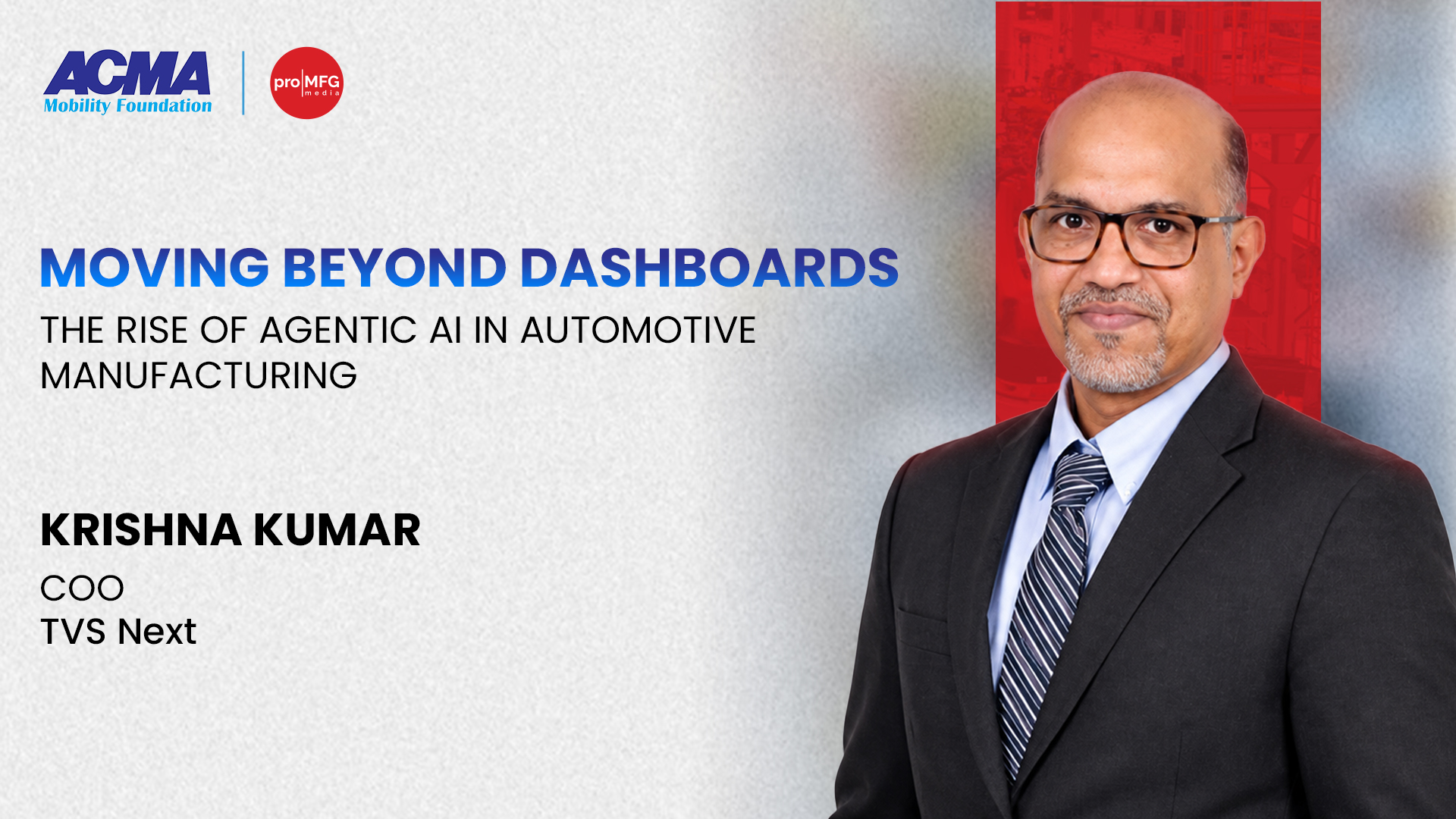
At the 4th Edition of the ACMA Automotive Smart Manufacturing Think Turf 2026 powered by Pro MFG Media, TVS Next COO - Krishna Kumar took the stage to highlight a massive industry shift. The summit’s overarching theme - Transforming Mobility: Innovation, Integration, and Impact - served as the backdrop for a compelling message: It’s time to move from control-led monitoring to orchestrated, agentic intelligence.
In business processes like finance or procurement, workflows are fairly uniform. A procure-to-pay cycle in Company A closely resembles the same process in Company B.
Manufacturing, however, is a different beast.
Shop floor operations are fiercely unique. A single plant can run multiple lines with completely different variations, requiring strict Six Sigma precision where even minor deviations directly impact the bottom line.
While consumer AI operates on probabilistic outcomes (like predicting what movie you might want to watch next), manufacturing demands deterministic reliability. You cannot afford to let a generative AI agent "hallucinate" a fix on an active automotive assembly line.
The Three Pillars of Orchestrated Intelligence
To bridge the gap between traditional automation and intelligent execution, Krishna Kumar outlined three core capabilities:
1. Building the Semantic Layer
Data without context is noise. The richest, most nuanced intelligence on any shop floor lives inside the heads of experienced operators. Digitizing human insights—capturing total productive maintenance (TPM) loss codes, quality checks, and shift handovers—creates a semantic foundation that feeds AI engines in an accurate real-world context.
2. Iterative Agent Execution
Unlike static control scripts, AI agents must learn, execute, and relearn dynamically. By evaluating real-time machine telemetry alongside SAP enterprise data, agents can automatically trigger maintenance workflows before a failure halts production.
3. Valuing the Human-in-the-Loop
An agentic factory does not eliminate human workers; it elevates them. The goal is to offload routine, repetitive data processing to intelligent agents while keeping operators in the loop for high-value, critical decision-making.
Closing out the session, TVS Next demonstrated their flagship platform, NexOps, designed to orchestrate this exact convergence.
By tying together edge sensors, transactional enterprise systems (ERP/QMS), and direct operator inputs (Jishu Hozen activities and loss tracking), NexOps creates a unified historian. When a downtime incident occurs, the system records not just that the line stopped, but why it stopped from the operator's perspective.
This continuous feedback loop allows predictive maintenance agents to assign targeted work orders, monitor active shift targets, and keep machine health operating at peak performance.
The transition to an agentic factory isn't an overnight switch - it is a continuous journey of orchestration, change management, and digital maturity. But for manufacturers aiming to stay competitive in 2026 and beyond, shifting from passive dashboards to active, orchestrated intelligence is no longer optional - it is the engine driving the future of mobility.

NEWSLETTER
TRENDING ON PRO MFG
MORE FROM THE SECTION