Accelerating Innovation: How Simulation Ensures Safety and Efficiency in Next-Gen Vehicles
#SimulationDriven #AIinEngineering #SustainableVehicles #AutomotiveTech #DigitalTwin #ADAS #FutureOfMobility
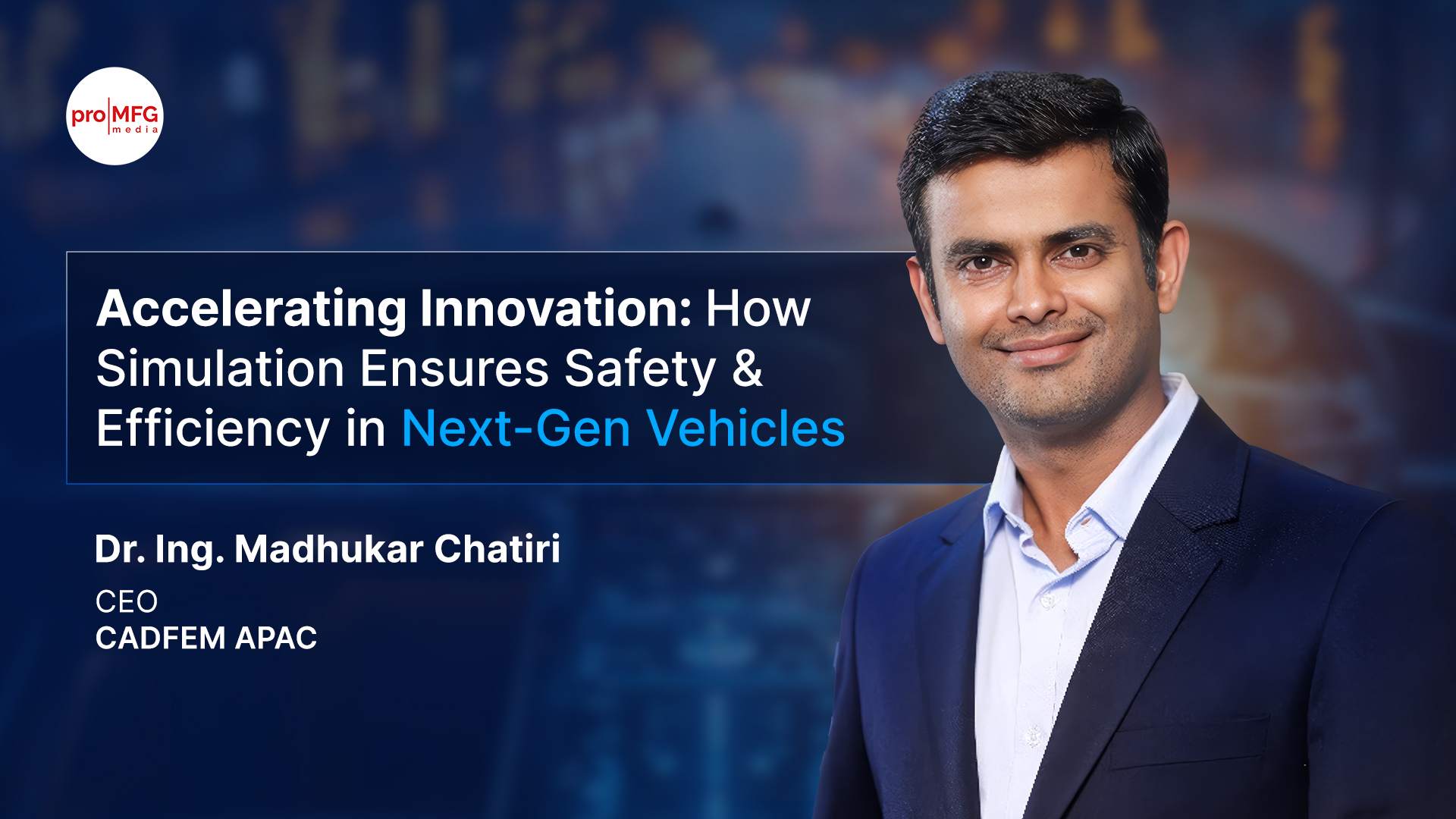
December 2025 : The automotive industry is undergoing a profound transformation, shifting from its mechanical heritage to an electronics-driven, autonomous landscape defined by complex systems and rigorous safety demands. This evolution, driven by factors like the push for autonomous technologies, increasing system complexity, and a global pivot towards sustainable vehicle design, necessitates a radical change in product development methodologies. To navigate this challenging but exciting environment, industry leaders are increasingly relying on advanced simulation-led workflows to accelerate innovation, ensure robust safety standards, and optimize for performance and sustainability.
In an exclusive interaction with Pro MFG Media, Dr-Ing. Madhukar Chatiri, CEO of CADFEM APAC, shared his expert insights on how simulation and digital twins have become non-negotiable tools in modern automotive engineering. As a global channel partner of Ansys, CADFEM is at the forefront of integrating multiphysics systems engineering with emerging technologies like Artificial Intelligence and Machine Learning (AI/ML).
How have simulation-led workflows transformed automotive product development in recent years?
CADFEM as the global channel partner of Ansys is witnessing a paradigm shift- from the mechanical roots of Industry 1.0 to the sensor-rich, electronics-driven landscape of Industry 4.0. Today’s automotive product development is heavily influenced by autonomous technologies from pioneers like Waymo and Zoox. Simulation has played a vital role in this evolution, enabling rapid innovation in electronics while continuing to ensure structural integrity, occupant safety, and efficient HVAC design. At the heart of this transformation is CADFEM’s multiphysics systems engineering, enabling seamless integration of diverse subsystems with unprecedented precision.
Can you share a key example where a digital twin or simulation significantly impacted a mobility project?
Every ADAS vehicle is an example of a product developed through Simulation Driven Digital Twins that have contributed to the stretch of Perceptual Intelligence to the ADAS vehicles. These vehicles are the result of simulation-driven digital twins- virtual replicas that allow engineers to model perception systems, sensor interactions, and real-world responses. The result is enhanced situational awareness and decision-making capability, which are critical to the safety and reliability of next-gen mobility platforms.
How is CADFEM integrating AI/ML into traditional engineering simulation tools?
At CADFEM, we’re actively fusing simulation with AI/ML to unlock predictive capabilities. Simulation data- be it scalar outputs, vector fields, or 3D plots- serves as a rich foundation for training machine learning models. Additionally, Reduced Order Models (ROMs) are used to distill complex simulation results into faster, lightweight surrogates, enabling real-time system optimization and design-space exploration with significantly reduced computational effort.
What role does simulation play in driving sustainable vehicle design and development?
Simulation is instrumental in building greener, more efficient vehicles. It supports sustainability goals by optimizing exhaust flow for reduced emissions, minimizing material usage while maintaining structural integrity, and enhancing ergonomic design. With simulation-led multi-objective optimization, engineers can balance performance, safety, and aesthetics while accelerating the path to cleaner transportation solutions.
What future trends do you foresee in simulation-led engineering, and how should teams prepare?
The future is incredibly exciting. The road ahead for CADFEM is marked by technologies like edge AI, ultra-fast embedded chips, enhanced functional safety automation, advanced LiDAR systems, responsive haptic interfaces, and vehicle-to-vehicle (V2V) communication infrastructure. To thrive in this landscape, engineering teams must embrace systems thinking and model-based development. Avoiding siloed approaches and adopting collaborative project management and digital engineering practices will be essential for keeping pace with innovation.
Dr.-Ing. Madhukar Chatiri is a seasoned leader with over 20 years of global experience in Simulation-Based Product Development (SBPD) and Digital Engineering. As the CEO of CADFEM India and SEA Pte. Ltd., he has been instrumental in establishing and scaling CADFEM's operations in the region since 2007, focusing on maximizing customer benefits through SBPD. He holds a dual degree in Mechanical Engineering, culminating in a Ph.D. from the University of Kassel with research on composite structures. His expertise spans computational material modeling, composite product development, and sustainable business initiatives.

NEWSLETTER
TRENDING ON PRO MFG



MORE FROM THE SECTION