Beyond Automation: Teaching Machines to Perceive, Reason, and Self-Correct
#DigitalTransformation #ProMFGMedia #SmartManufacturing #FutureOfMobility #AutomotiveInnovation #SustainableManufacturing #Industry40 #AutomotiveLeadership #EVIndia #ACMAThinkTurf2026"True intelligence isn't just streaming data to a screen. It's building machines that perceive their environment, reason through problems, learn from patterns, and act autonomously to fix errors before they happen." - Dr. Rajkumar Swaminathan, President, Rane (Madras) Ltd. - Engine Component Division
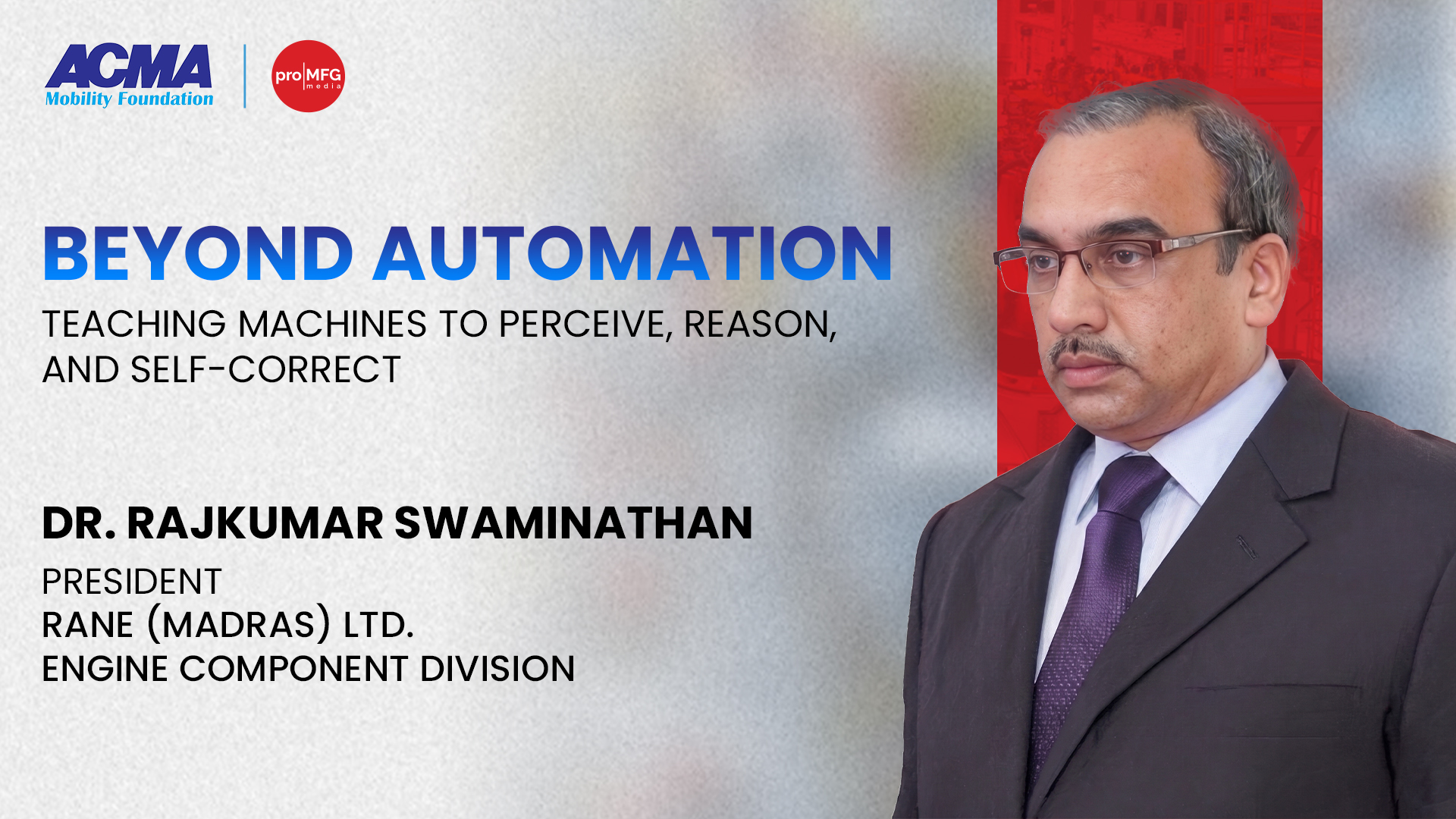
August 2026 : There is a massive difference between a factory that is merely automated and one that is genuinely intelligent. While most plants have mastered collecting data and motorizing repetitive tasks, the real leap forward happens when machines stop waiting for human intervention and start solving problems on their own.
At the 4th Edition of the ACMA Automotive Smart Manufacturing Think Turf 2026 powered by Pro MFG Media, industry leaders met under the banner Transforming Mobility: Innovation, Integration, and Impact.
During the panel on "Gears of Automotive Growth: Resilient, Automated & Intelligent Manufacturing," Dr. Rajkumar Swaminathan, President at Rane (Madras) Ltd. - Engine Component Division, discusses what true intelligent manufacturing actually means - and how to align cross-departmental innovation with measurable business goals.
Here are two key takeaways from their conversation on building shop floors that don't just react, but continuously think and adapt.
1. Defining Intelligent Manufacturing: Perceive, Reason, Learn, Act
Many inside manufacturing equate "smart operations" with simple process automation or basic data logging. Dr. Swaminathan sees it differently. For him, true intelligence isn't reactive - it is deeply proactive.
"When I interact with people, they often talk about digitalization and automation interchangeably," Dr. Swaminathan noted. "To me, intelligence goes far beyond that. The machine should be able to perceive, reason through the cause, learn from past inputs, and act on its own."
Shop Floor Intelligence = Perceive → Reason → Learn → Autonomous Action
While most facilities are still taking their initial steps on this journey, the target destination must remain autonomous, closed-loop systems. Instead of merely alerting a technician that an engine valve or component is drifting out of tolerance, an intelligent system identifies the root cause and recalibrates itself in real time to prevent defects altogether.
2. Unlocking Innovation: Bake It Into the Annual Operating Plan
Cross-functional collaboration across operations, engineering, R&D, and supply chain often stumbles over a common hurdle: competing priorities. Teams naturally focus on their immediate departmental targets rather than shared, strategic goals.
How do you break down these operational silos and accelerate the pace of innovation?
Dr. Swaminathan’s blueprint is straightforward: directly tie innovation targets to the Annual Operating Plan (AOP).
"When you link innovation to the annual operating plan, people are naturally aligned toward achieving those core business objectives," he explained. "More importantly, resources automatically get allocated. That drives speed and helps organizations realize their full potential much faster."
When innovation moves from an informal, side-desk activity to a budgeted KPI inside the master operating plan, cross-departmental friction drops, funding is secured, and execution speeds up across the board.
As the Indian automotive ecosystem transitions toward scalable digital platforms, real-time edge processing, and resilient multi-plant networks, the message from industry leaders is clear. Real growth requires moving past vanity metrics and isolated pilot projects. By building machines that learn autonomously and embedding innovation directly into corporate planning, manufacturers can convert digital promises into real-world business impact.

NEWSLETTER
TRENDING ON PRO MFG


MORE FROM THE SECTION