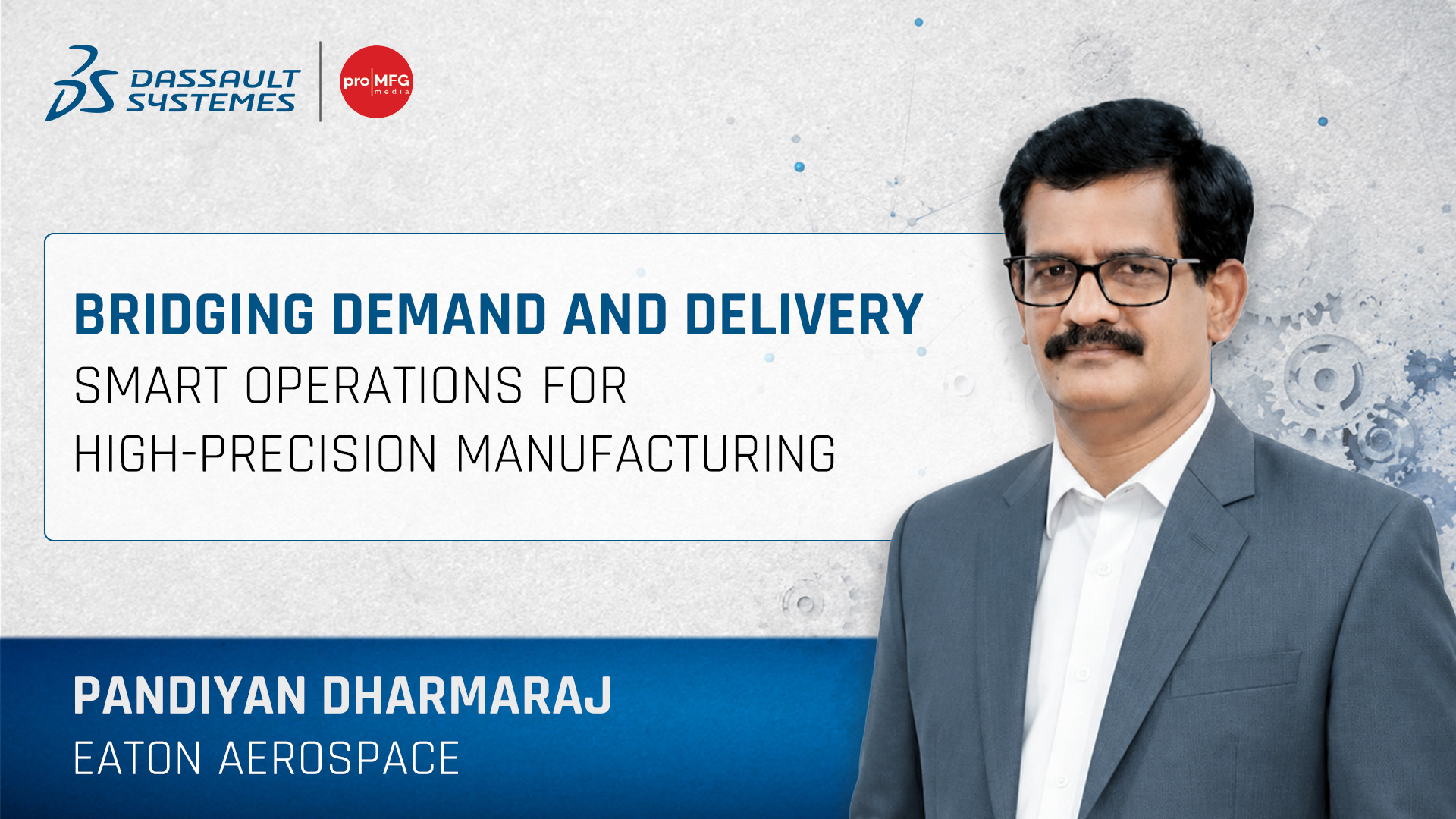
Bridging Demand and Delivery: Smart Operations for High-Precision Manufacturing
#ProMFGMedia #SmartManufacturing #Operationalexcellence #DassaultSystèmes #AerospaceIndustry #Industry40 #LeanManufacturing #SupplyChainIntegration #EATONAerospace #GembaWalk“Automation doesn’t replace human insight - it elevates it. Real operational excellence happens when leaders step onto the shop floor, listen to the Gemba, and solve problems at the source.” - Pandiyan Dharmaraj, Eaton Aerospace
September 2026 : In the high-stakes world of aerospace manufacturing, precision isn't just an asset - it’s a mandatory standard. Every component must meet strict quality metrics, leaving zero margin for error or operational delay.
At the “Driving Profitable Growth Through Smart Manufacturing” roundtable - presented by Dassault Systèmes and Tata Technologies, powered by Pro MFG Media, and supported by ACMA India - Pandiyan Dharmaraj from Eaton Aerospace shared how his team achieved a world-class manufacturing model plant status. The secret to their operational excellence isn't hidden behind expensive software dashboards; it is rooted in a structured culture of listening at the shop floor level, combined with deep supply chain integration.
Many factory floors struggle because operator concerns get buried under administrative noise. At Eaton Aerospace, operational efficiency is driven by a disciplined hierarchy of daily Tier meetings - starting at Tier 1 on the shop floor and escalating smoothly through Tier 2, Tier F, and Tier 3.
This structured communication flow ensures that 60% to 70% of operational issues are resolved locally before ever reaching senior management.
Whether dealing with machine breakdowns, tooling wear, or minor quality variations, frontline supervisors don't just assign tasks - they systematically capture feedback.
Frontline operators often hesitate to flag issues through formal channels. Eaton overcomes this barrier by practicing genuine leadership presence at the Gemba - the actual place where value is created on the factory floor.
"Irrespective of leadership level, our teams perform Gemba walks to ask a simple question: What is your challenge today?" Dharmaraj explained.
By actively listening to frontline workers instead of managing from behind a desk, leaders build trust. When operators know their feedback leads to immediate action, they open up about subtle line bottlenecks, turning daily friction points into continuous improvement opportunities.
While internal communication keeps factory lines humming, external market volatility presents an ongoing challenge. Even with strong order backlogs and steady customer demand, fluctuating material availability can stall production.
Dharmaraj highlighted that the next major frontier for smart manufacturing lies in the seamless integration of supply chain systems directly into shop-floor operations.
By connecting live supplier data with internal production schedules, plant managers can dynamically adjust line priorities based on incoming material availability. This end-to-end integration ensures that high demand translates directly into reliable, on-time customer delivery without compromising aerospace-grade quality.
Operational excellence isn't built overnight through technology alone. It requires a resilient foundation where shop-floor workers are heard, problems are solved at the Gemba, and supply chains are dynamically synced with daily operations. By putting people and processes first, manufacturers can navigate market volatility and drive long-term profitable growth.

NEWSLETTER
TRENDING ON PRO MFG



MORE FROM THE SECTION