Digital Twins and Carbon Compliance: How Indian Foundries Are Preparing for a Net Zero Future
#CarbonCompliance #NetZero #DigitalTwin #SustainableManufacturing #ESG“This is the need of the hour. With carbon regulations tightening globally, digital twins, MES, and AI are essential to monitor, forecast, and control emissions across the manufacturing lifecycle.” - Mr. Srinivasa Rao, Chief Operating Officer- Foundry Division, Madras Engineering
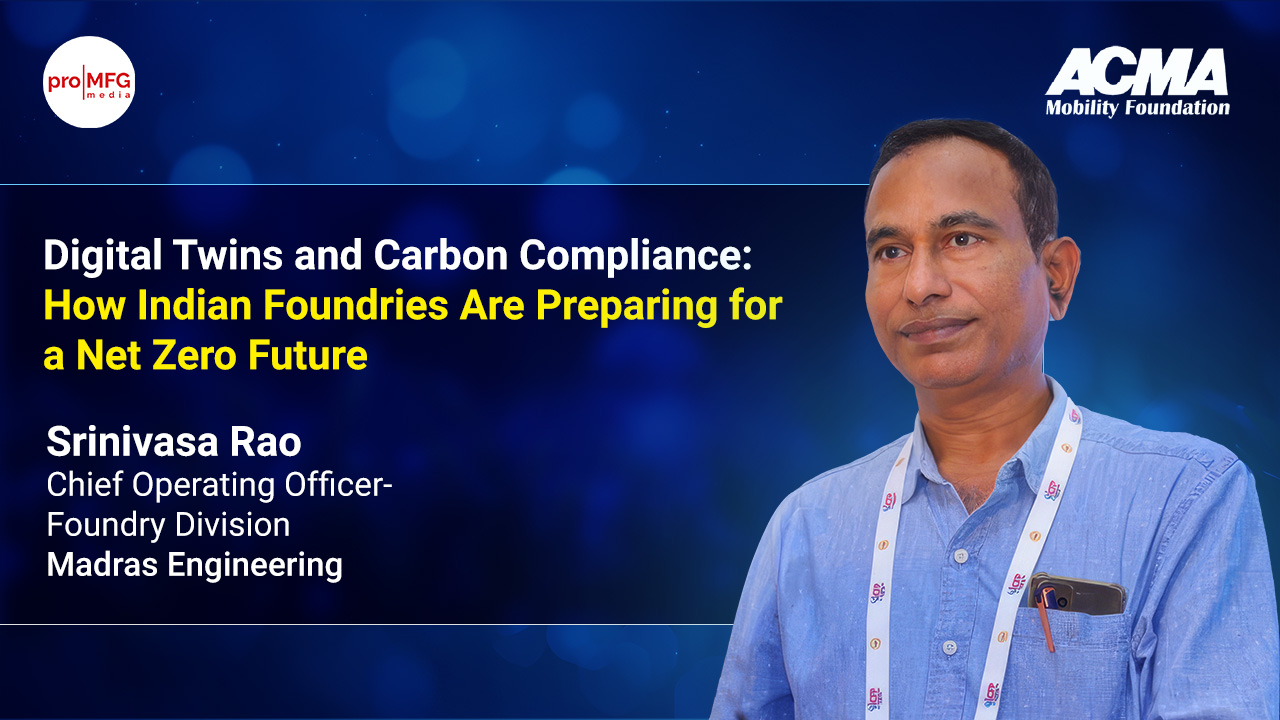
November 2025 : As global regulations tighten around carbon emissions, integrating ESG goals into advanced manufacturing strategies has shifted from optional to essential. Mr. Srinivasa Rao, Chief Operating Officer - Foundry Division, Madras Engineering, shared how digital technologies such as MES, AI, and digital twins are helping Indian manufacturers prepare for upcoming carbon regulations and position themselves competitively in global markets.
“This is the need of the hour. We cannot operate factories the way we do today,” Mr. Rao asserted. The urgency stems from sweeping policy changes, particularly in the European Union. From January 1, 2026, the Carbon Border Adjustment Mechanism (CBAM) will fully come into effect, requiring exporters of six identified product categories to declare their carbon footprint and stay within strict thresholds or face carbon taxes. In parallel, the Corporate Sustainability Reporting Directive (CSRD) mandates over 40,000 companies in the EU (and about 10,000 outside it) to report on sustainability performance.
“This framework is setting the tone globally,” he explained. “Korea and Japan have already begun adopting similar measures, and North America will follow. For Indian industries, complying with environmental laws and mitigating carbon emissions across the product life cycle will soon become a license to operate.”
Madras Engineering has been ahead of the curve, launching a “Fossil-Free Casting” initiative to produce castings with minimal cradle-to-gate carbon footprint. “This is the least carbon footprint achievable in the world today for castings,” Mr. Rao said proudly.
Technologies like digital twins play a crucial role in this transformation. By integrating energy meters, water systems, air usage data, and production processes into a real-time digital dashboard, Madras Engineering can monitor and optimize resource consumption and carbon emissions across departments.
“Digital twins help us forecast the potential carbon footprint of new products through life cycle assessments,” Mr. Rao explained. “AI can then recommend efficiency parameters to ensure emissions stay within thresholds. This is how technology enables sustainable manufacturing.”
He also reminded the audience that India, as a signatory to the Paris Agreement, has committed to achieving net zero by 2070. “Unless we embrace these technologies, it will be very difficult to export in the future,” he cautioned.
Mr. Srinivasa Rao shared these insights as a panelist during the 3rd Edition of the ACMA Automotive Smart Manufacturing Think Turf, powered by Pro MFG Media, in a discussion on “Advanced Factory Management and Optimization.”

NEWSLETTER
TRENDING ON PRO MFG



MORE FROM THE SECTION