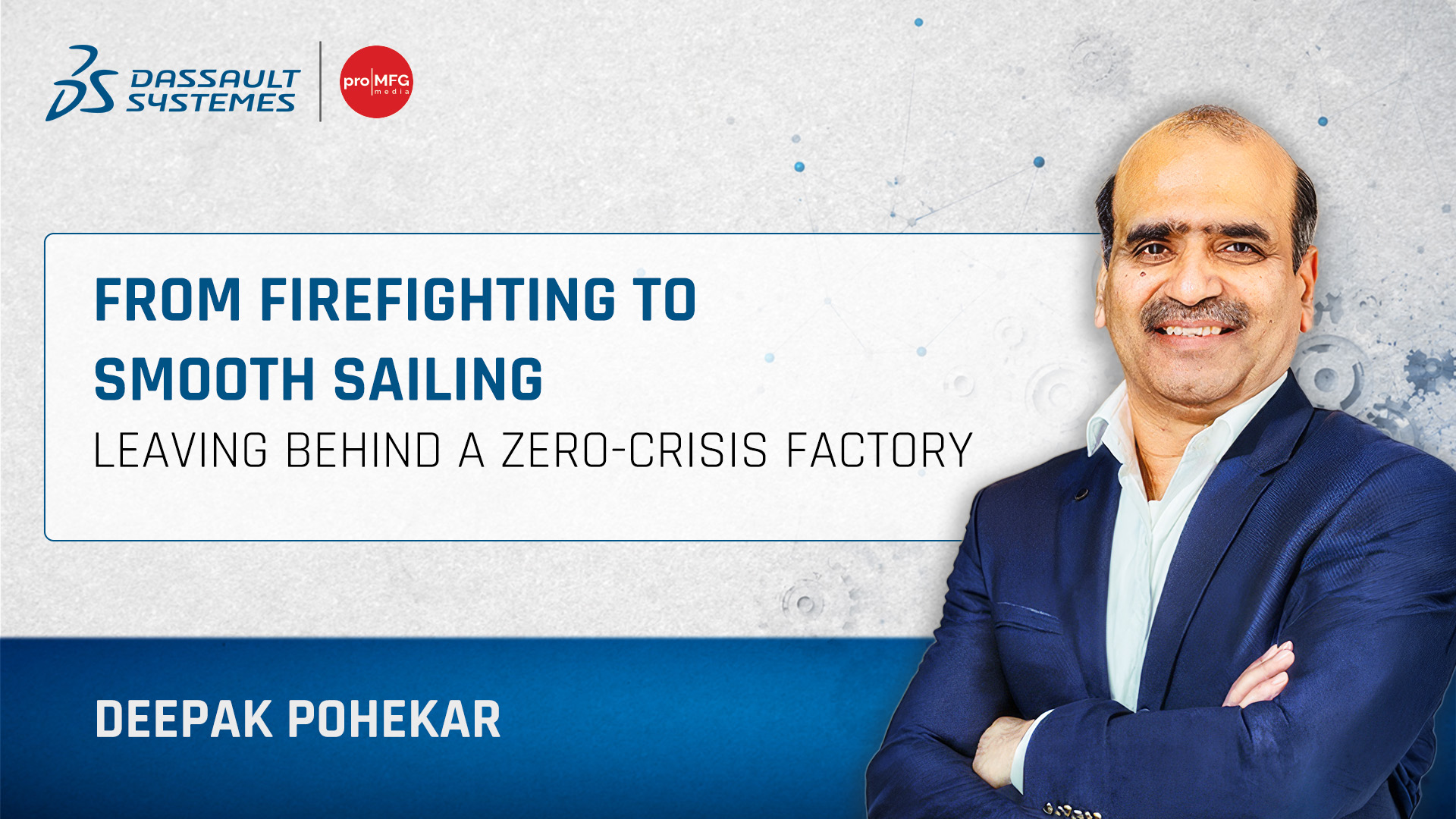
From Firefighting to Smooth Sailing: Leaving Behind a Zero-Crisis Factory
#Upskilling #SmartManufacturing #Operationalexcellence #DassaultSystèmes #TataTechnologies #ProMFG #Industry40 #LeadershipInTech #HumanCentricAI #DataStrategy“A screwdriver won’t tell you which screw to remove - human intelligence does. Technology gives you speed, but people give you direction.” - Deepak Pohekar
August 2026 : For decades, the manufacturing playbook prioritized cheap labor to keep margins tight and overhead low. But in an era where single machines cost $3 million and operate with 125 complex tools, that old math no longer works.
At the “Driving Profitable Growth Through Smart Manufacturing” roundtable - presented by Dassault Systèmes and Tata Technologies, powered by Pro MFG Media, and supported by ACMA India, Deepak Pohekar delivered a masterclass on modern shop-floor dynamics. Drawing from a 40+ year career that began in late-night firefighting as a maintenance engineer and culminated in a seamless executive retirement, Pohekar turned conventional wisdom on its head: the biggest barrier to high-tech adoption isn't budget or software - it's how we value human capital.
Companies often pay a high, hidden tax for low-cost, untrained labor through damaged tooling, machine downtime, and poor quality. Pohekar’s counter-strategy is straightforward: hire local, employ on-role, pay well, and continuously upskill.
Rather than relying on transient workforces, his approach focuses on recruiting diploma and degree holders for shop-floor operations. To maximize their potential, his plant trained nearly 100 shop-floor staff in advanced tools like Power BI and Power Automate.\
"If an engineer doesn't find a worthy role in industry, they go drive a taxi," Pohekar noted. "When you hire educated talent, treat them with dignity, and train them to manage complex systems, they stop just pulling levers and start solving problems."
Addressing the hype around Artificial Intelligence, Pohekar offered a practical perspective. AI cannot fix broken operational logic; it can only accelerate existing processes.
"AI will increase your speed from point A to point B. Whether you fly or drive, where you choose to go is still a human decision."
For AI to deliver true predictive power - moving factories from constant firefighting to proactive maintenance - it requires massive amounts of clean, structured data. Pohekar's advice to leaders is simple: Start hoarding operational data immediately. Even if your plant lacks mature analytics tools today, collecting historical machine logs, quality metrics, and maintenance records ensures that when advanced models are deployed, the "food" for AI is already waiting.
Technology frequently fails because data remains trapped in departmental organizational silos. Pohekar recalled a machine with chronic breakdown issues where maintenance, quality, production, and process engineering teams worked independently. Each engineer adjusted settings to solve their localized problem, unknowingly creating issues for the next department.
The fix wasn't an expensive software upgrade; it was creating a shared logging mechanism and forcing cross-functional alignment.
"The data was there, but nobody was sharing it," Pohekar explained. "Once you break those silos and feed integrated cross-functional data into smart systems, chronic failures vanish."
Pohekar’s ultimate measure of success? Leaving behind a plant so well-structured, data-driven, and human-centric that his successor faced zero operational fires during their first two months on the job.
As he embarks on a doctorate program researching AI’s impact on manufacturing productivity, his message to the industry remains clear: digital tools will make operations faster, but solving root problems through empowered people is what makes them profitable.

NEWSLETTER
TRENDING ON PRO MFG


MORE FROM THE SECTION