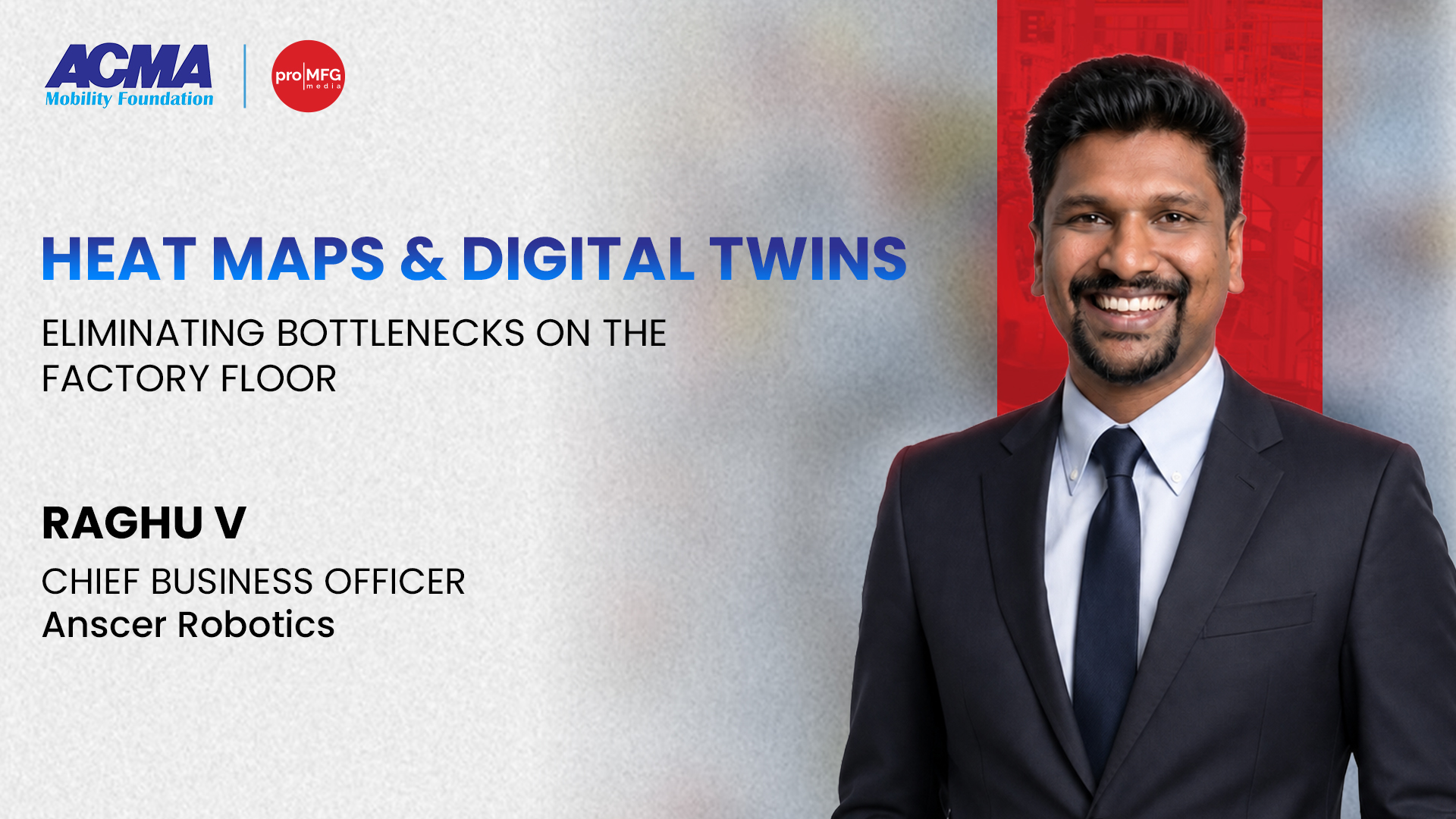
Heat Maps and Digital Twins: Eliminating Bottlenecks on the Factory Floor
#ACMAThinkTurf2026 #SmartManufacturing #AutomotiveInnovation #FutureOfMobility #Industry40 #DigitalTransformation #ProMFGMedia #SustainableManufacturing #EVIndia #AutomotiveLeadership"Automation doesn't magically fix plant efficiency on day one. Real transformation happens when machines start observing what humans miss - and AI gives every operator the clarity of a supervisor." - Raghu V, Chief Business Officer, Anscer Robotics
September 2026 : In the world of high-stakes automotive manufacturing, there is an invisible thief at work. It doesn't show up on maintenance logs, nor does it trigger emergency alarms on the MES dashboard. It is the "hidden plant tax" - the silent accumulation of micro-bottlenecks, aisle congestion, and fragmented software routines that slowly bleed a facility’s throughput dry.
Under the theme “Transforming Mobility: Innovation, Integration, and Impact,” at the 4th Edition of the ACMA Automotive Smart Manufacturing Think Turf 2026 powered by Pro MFG Media industry leaders gathered to tackle a hard truth: collecting data is easy, but making it useful is where most manufacturers stumble. During the panel session “From Data to Decisions: Capitalizing on Advanced Technology for Plant Performance,” Raghu V, Chief Business Officer at Anscer Robotics, flipped the narrative on what industrial robots are actually built to do.
1. The Day-One Automation Myth
Most plant directors assume that deploying autonomous robots yields immediate peak productivity. In reality, day one rarely looks like the brochure.
When mobile robots begin navigating a facility, their primary value isn't just carrying heavy loads from point A to point B - it is observation. Equipped with sensors and vision systems, robots map physical reality in real time.
What the Robots Saw: In several automotive plants, Anscer Robotics discovered that mobile units were generating heat maps of floor congestion. They flagged aisles being used as unofficial storage zones and identified recurring shift-change traffic jams that never appeared on conventional MES or ERP reports.
By comparing heat map data across different shifts, plant managers finally saw why target throughput wasn't matching real-world output. The data didn't just measure performance; it pinpointed the exact physical roadblocks slowing people down.
2. Digital Twins: Simulating Tomorrow’s Layouts Today
Finding a bottleneck on the shop floor is only half the battle; fixing it without shutting down production is the real test.
This is where digital twins step in. Rather than moving physical equipment on a hunch, plant engineers use historical and real-time floor data to run virtual simulations. Want to redesign a material-handling route or alter line pacing? Digital twins allow teams to test layout changes in a risk-free environment, predicting bottlenecks before a single bolt is turned.
3. Democratizing Tech: Unifying the Screen Jungle
Perhaps the most practical hurdle facing shop-floor teams today is system fragmentation. Operators routinely jump between four different software applications - from MES and ERP to quality control modules - just to complete a standard task.
Raghu pointed out that the next leap in AI isn't about complex algorithms - it’s about simplification:
- • Contextual Dashboards: Instead of forcing workers to hunt through menus, AI surfaces the exact information needed at that specific second.
- • Leveling the Playing Field: Unified AI interfaces allow line-level workers to operate complex software with the same speed and confidence as experienced plant supervisors.
Smart manufacturing isn't about filling a facility with hardware and staring at graphs. True impact happens when technology reveals the invisible friction on the floor and empowers the workforce to solve it effortlessly. When robots become intelligent observational partners and AI turns complex software into simple choices, data finally turns into decisive action.

NEWSLETTER
TRENDING ON PRO MFG



MORE FROM THE SECTION