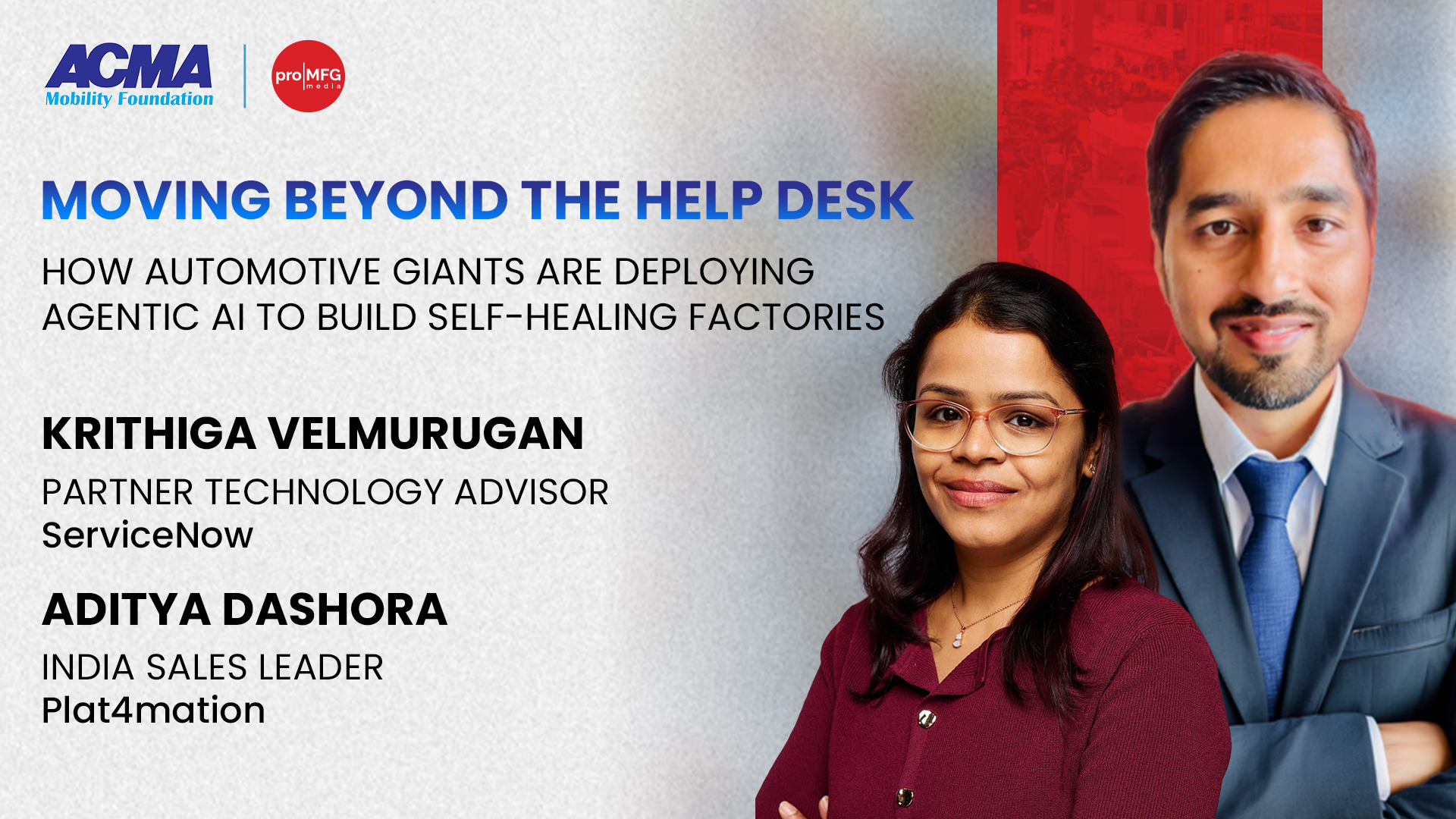
Moving Beyond the Help Desk: How Automotive Giants Are Deploying Agentic AI to Build Self-Healing Factories
#MobilityReimagined #SmartManufacturing #ServiceNow #Plat4mation #AgenticAI #OTSecurity #SupplyChainResilience #DigitalBackbone #ACMAThinkTurf #SelfHealingInfra"The upcoming automotive era isn't just about faster product cycles; it’s about operating in a state of permanent disruption. If your systems can't flag a supply risk and adjust shipping routes before a human even makes a phone call, you aren't running an intelligent factory." - Krithiga Velmurugan, Partner Technology Advisor, ServiceNow
September 2026 : The modern automotive landscape is being squeezed from all sides. Global manufacturers are juggling highly volatile supplier networks, intense cost pressures, accelerated product cycles forced by the EV transition, and a workforce that is increasingly difficult to scale.
For industry leaders, the verdict is clear: this is no longer a temporary patch of rough weather. It is the new, permanent operating reality.
The question is no longer how to weather the storm, but whether factory operations are integrated enough to outpace it. This core challenge was addressed by Krithiga Velmurugan, Partner Technology Advisor at ServiceNow, and Aditya Dashora, India Sales Leader at Plat4mation, during a platinum partner presentation at the 4th Edition of the ACMA Automotive Smart Manufacturing Think Turf 2026, powered by Pro MFG Media.
Under the summit's banner - Transforming Mobility: Innovation, Integration, and Impact - the duo pulled back the curtain on how modern automotive operations are transitioning away from disconnected "point tools" and moving toward a single, intelligent digital backbone.
For many outside the enterprise IT sphere, ServiceNow is traditionally recognized as a corporate help desk or an internal IT ticketing system. However, the data coming out of the automotive sector tells a vastly different story.
Today, ServiceNow powers over 8,800 global customers - including 90% of the Fortune 500. Velmurugan highlighted a striking trend within the automotive ecosystem: 76% of automotive companies using ServiceNow have expanded the platform far beyond IT support.
Instead, they are running their core quality, production, frontline HR, and supply chain operations on it. By anchoring five critical pillars - Operational Technology (OT), IT infrastructure, Supplier Lifecycles, Risk/Cybersecurity, and Employee Safety - onto one unified platform, companies eliminate the need for human intermediaries to manually transfer critical information between fragmented software systems.
The financial and operational outcomes of this single-platform approach across global manufacturing are substantial:
- Scania: Saving €1.8 million every month.
- • Rivian: Achieving a 10x reduction in supplier onboarding time.
- • Mercedes-Benz: Delivering 90% faster support times across its dealer networks.
- • Schaffler: Automating 75% of its purchase order processing.
To demonstrate that these aren't just high-level corporate roadmaps requiring three-year transformation timelines, Velmurugan walked the audience through a live simulation modeled on their work with global automotive giant Stellantis. The demo highlighted how specialized AI agents natively execute complex cross-departmental tasks on the factory floor in minutes.
1. The Supply Chain Specialist Persona: When an AI agent detects a sudden, proactive risk - such as an automated flag indicating that a battery supplier has increased its pricing - it doesn't just alert the human specialist. Using an advanced workflow data fabric, the AI autonomously searches internal and external networks, identifies an alternate approved supplier (e.g., Redpath Energy) within budget, recalculates shipping routes, amends the purchase order, and presents the specialist with a completed mitigation plan to approve with a single click.
2. The Network Operations Persona: When localized network degradation threatens a physical SCADA system or a PLC line on the assembly floor, the system's "self-healing" mechanics take over. The AI agent automatically interrogates third-party monitoring tools like New Relic, analyzes recent server updates, identifies a faulty Kubernetes deployment, executes a safe system rollback, verifies that production line telemetry has returned to normal, and drafts an internal knowledge article for future engineering reference - all without the operator ever leaving the main dashboard.
This complete integration culminates at the executive level. Through Plat4mation’s tailored implementation frameworks - including specialized co-developed products like the Industrial Connected Workforce - CXOs gain access to a centralized AI Control Tower (AICT).
As Dashora emphasized, expanding an automotive footprint means managing an increasingly dense network of OT assets. An unmanaged, invisible OT asset base is simply a ticking security and operational time bomb.
The AI Control Tower provides a single, transparent window for the CIO or Plant Head to monitor exactly which AI agents are running across multiple global plants, verify their exact value realization, and proactively catch security vulnerabilities before they can trigger unplanned downtime.
The playbook for modern automotive manufacturing has shifted. The companies pulling ahead are no longer the ones waiting for massive, multi-year IT overhauls. The winners are those identifying individual operational friction points, layering intelligence over them, and systematically building an automated, resilient value chain from the shop floor up.

NEWSLETTER
TRENDING ON PRO MFG
MORE FROM THE SECTION