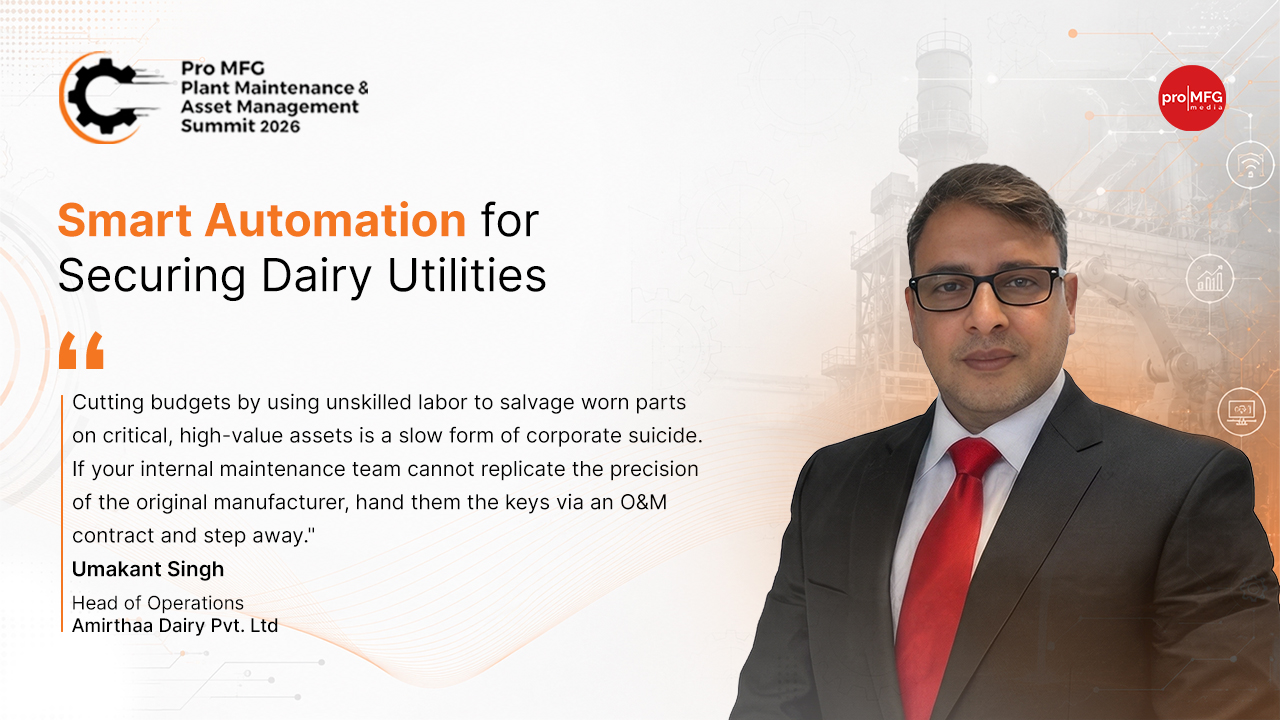
Smart Automation for Securing Dairy Utilities
#ProMFG2026 #PMAMSummit #SmartMaintenance #DairyAutomation #UtilityEngineering #WaterReclamation #EffluentTreatment #ProcessOptimization #CoimbatoreManufacturing"Cutting budgets by using unskilled labor to salvage worn parts on critical, high-value assets is a slow form of corporate suicide. If your internal maintenance team cannot replicate the precision of the original manufacturer, hand them the keys via an O&M contract and step away." - Umakant Singh, Head of Operations - Amirthaa Dairy Pvt. Ltd
June 2026 : There is a persistent, outdated misconception outside the sector that dairy processing is a relatively low-tech, traditional business - simply a matter of moving fresh milk from trucks into cartons. In reality, modern dairy processing is an unforgiving, hyper-regulated environment. To convert raw liquids into high-grade powders that satisfy strict regulatory parameters, facilities must deploy some of the most complex thermal engineering, process-flow piping, and automated control software in the world. In this arena, operational excellence requires running high-volume assets at peak efficiency without allowing short-sighted maintenance shortcuts to compromise product safety or baseline uptime.
This exact intersection of automation and asset discipline anchored the final panel track at the 7th Edition of the Pro MFG Plant Maintenance & Asset Management (PMAM) Summit 2026 in Coimbatore. Hosted by Pro MFG Media alongside Presenting Partner - Mobil and Gold Partner - ImageGraphix, the summit focused on Achieving Maximum - Driving Productivity & Cost Efficiency Across Assets.
Bringing a practical, hands-on operational perspective to the stage was Umakant Singh, Head of Operations at Amirthaa Dairy Pvt. Ltd. With 25 years of engineering and project management experience, Singh detailed how his facility completely transformed its cost structure by treating utility infrastructure as a self-sustaining ecosystem.
When manufacturers focus on cutting costs, they often try to squeeze extra margins by reducing preventive maintenance budgets, utilizing cheaper, unvouched third-party spare parts, or assigning high-precision overhauls to unskilled internal labor. Singh strongly warned against this approach, noting that it creates a cycle of unpredictable equipment breakdowns. Instead of reducing engineering quality, Amirthaa Dairy optimized its operations by removing the human factor from utility management altogether through targeted automation. By designing an entirely closed-loop network, the plant operates its chilled water lines, high-pressure air compressors, RO purification units, and soft-water pumping systems with zero dedicated operators. Instead, the entire utility infrastructure communicates dynamically via automated pressure-retaining valves and intelligent sensor networks. If a line requires 7kg of operational pressure, the auxiliary assets start and synchronize automatically, eliminating human response delays and reducing expensive factory floor idle time.
Because heating steam and industrial chilled water represent the two largest financial components of a food processing plant's manufacturing cost, optimizing resource consumption is vital to protecting the bottom line. To combat escalating municipal utility expenses, the Amirthaa Dairy facility processes 4 lakh liters of daily plant effluent water. This advanced reclamation loop generates between 3.2 and 3.4 lakh liters of high-purity RO water every day, providing nearly 80% of the factory's 5-lakh-liter daily water footprint for non-contact applications. Simultaneously, during peak summer processing windows, the treatment facility captures 200 cubic meters of volatile bio-gas from the effluent. This gas is diverted straight into the plant's main boilers, saving two metric tons of commercial fuel every single day while insulating the plant from volatile energy markets.
When the panel turned to optimizing maintenance budgets without hurting asset reliability, Singh urged leaders to respect the original equipment manufacturer's (OEM) design rules. If an asset is designed to operate seamlessly for three years under structured, yearly overhauls, skipping that service window to save a few thousand rupees short-circuits the machine's long-term lifecycle math. If an internal engineering team lacks the precision or specialized tools to run these complex overhauls to original tolerances, the most cost-effective solution is to move to a formal Operations and Maintenance (O&M) contract with the supplier. True cost optimization isn't about making maintenance cheaper; it's about eliminating operational variance, stabilizing your supportive utilities, and letting your core assets run uninterrupted.

NEWSLETTER
TRENDING ON PRO MFG


MORE FROM THE SECTION