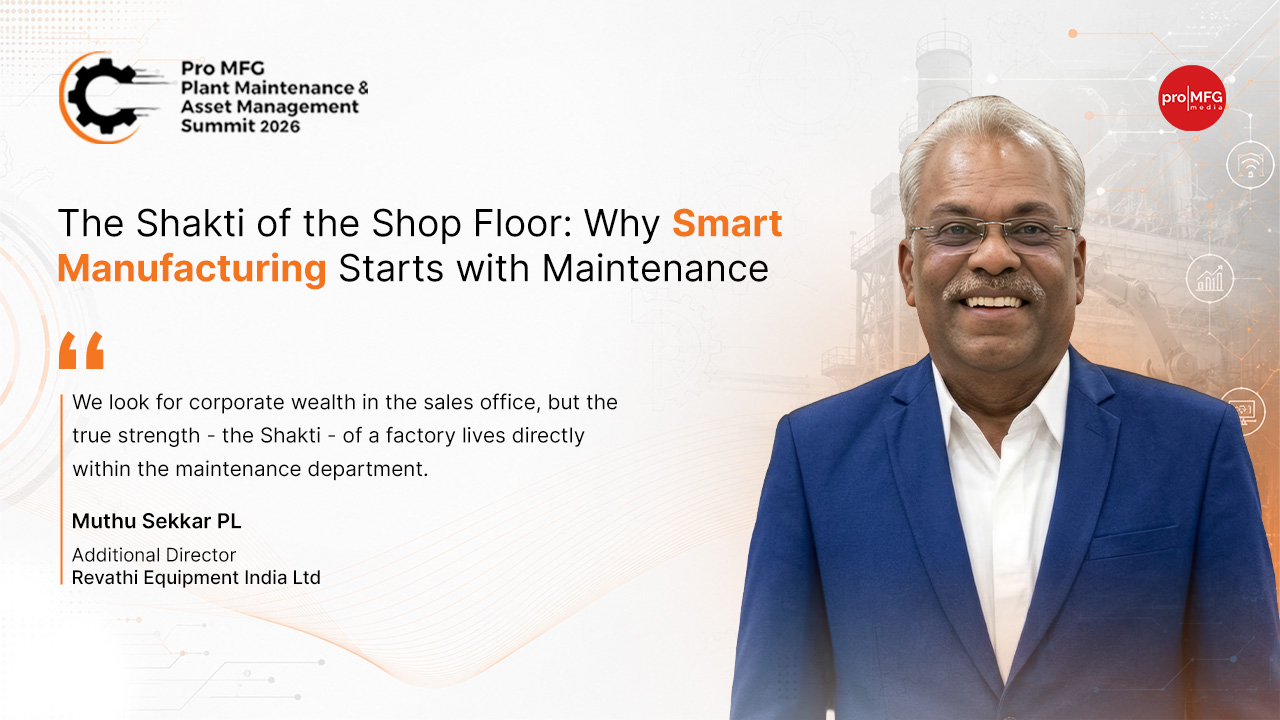
The Shakti of the Shop Floor: Why Smart Manufacturing Starts with Maintenance
#ProMFG2026 #PMAMSummit #SmartMaintenance #PlantOperations #ReliabilityEngineering #IndustrialCulture #Operationalexcellence #AssetManagement #RevathiEquipment"We look for corporate wealth in the sales office, but the true strength - the Shakti - of a factory lives directly within the maintenance department." - Muthu Sekkar PL, Additional Director, Revathi Equipment India Ltd
June 2026 : For decades, the standard corporate playbook dictated that entering the world of smart manufacturing required massive capital expenditure, pristine new machinery, and armies of external tech consultants. Legacy equipment was viewed as a hurdle - silent, analog iron incapable of communicating in a cloud-driven world.
This core philosophy took center stage at the 7th Edition of the Pro MFG Plant Maintenance & Asset Management (PMAM) Summit 2026 in Coimbatore. Hosted by Pro MFG Media alongside Presenting Partner Mobil and Gold Partner ImageGraphix, the panel tackled the realities of Smart Maintenance - Leveraging Digital Tools for Reliable Plant Operations.
Delivering a powerful, human-centric reality check to the room was Muthu Sekkar PL, Additional Director of Revathi Equipment India Ltd. With decades of industrial leadership, Sekkar highlighted that the biggest hurdle to smart maintenance isn't a lack of technology - it is the abandonment of fundamental discipline.
When asked about the premier challenges facing shop floors today, Sekkar sidestepped technical jargon entirely. Instead, he targeted a universal operational flaw: the failure to sustain basic discipline. "The fundamental challenge is that good practices are simply not being followed," Sekkar remarked. "Every factory has them at some point - whether it's precise tracking reports, regular asset health checkups, or disciplined review meetings. But somewhere along the line, they fall by the wayside." He challenged the audience to go back to their shop floors and audit why successful, time-tested habits were quietly stopped in the first place.
To prove that effective maintenance does not always require massive data processing, Sekkar shared a historic engineering example from his 30-year journey in the gear industry. In the early 1990s, certain German-designed windmill gearboxes featured a brilliant prism mechanism. Operators standing safely on the ground could look up at a 30-meter tower and clearly view the internal oil level through a simple lens. No complex sensors, no data streams, no wireless networks - just brilliant, elegant engineering that solved a problem instantly.
As factories pile on internet-connected sensors, they frequently encounter a new operational hazard: information overload. "Too much analysis leads to paralysis," Sekkar warned. "The question we must ask is whether we are capturing relevant, actionable data, or just drowning in numbers." This distinction is crucial given today's tight macroeconomic environment. With geopolitical uncertainties driving strict capital expenditure (capex) freezes, factories cannot simply buy their way out of legacy machine issues. Success depends on maximizing current operating expenditure (opex) through intelligent maintenance and smart Annual Maintenance Contracts (AMCs).
Ultimately, true smart maintenance requires a complete cultural evolution. Historically, the maintenance department has been relegated to the quietest corners of the facility, overlooked until something goes wrong.
Sekkar argued it is time for a profound mindset shift, pointing out that maintenance professionals rarely ascend to corporate leadership roles like CEO. By reshaping how organizations value asset care, incentivizing maintenance teams, and elevating shop floor reliability into a core business strategy, the industry can finally bring its foundational workers into the spotlight they deserve.

NEWSLETTER
TRENDING ON PRO MFG



MORE FROM THE SECTION