The Magic of Retrofitting: Breathing Smart Life into Legacy Assets
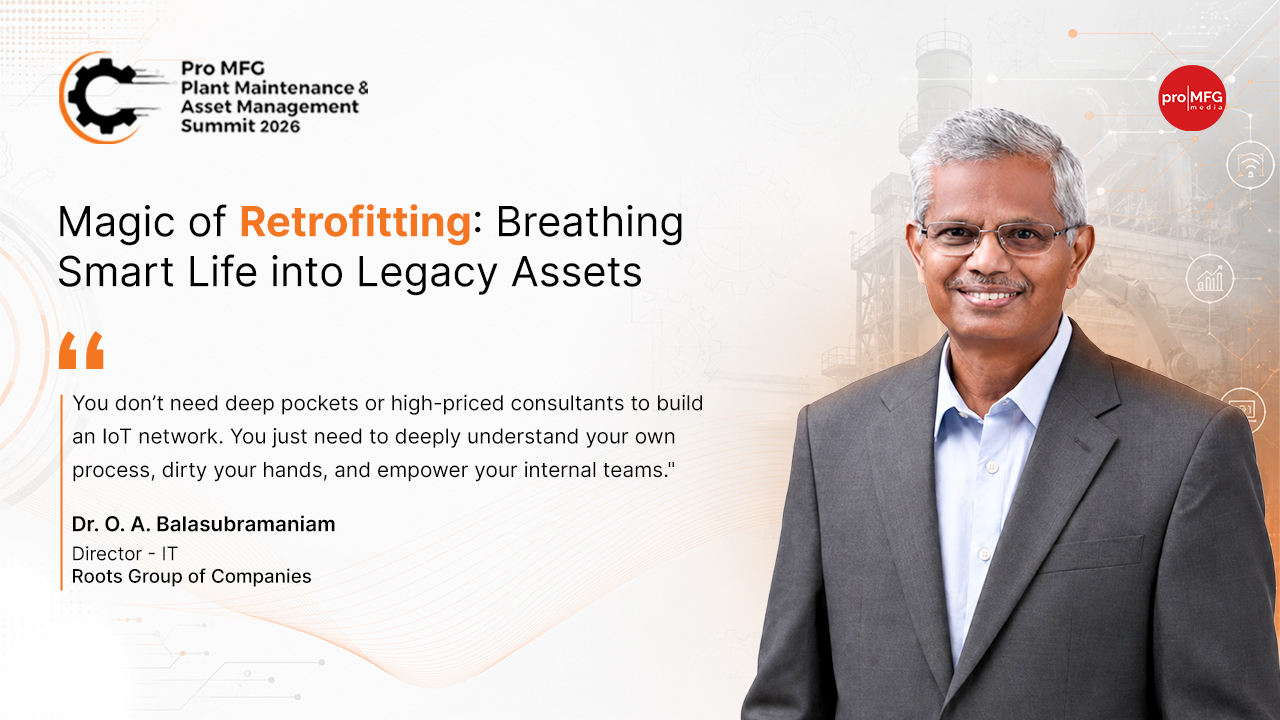
#ProMFG2026 #PMAMSummit #SmartMaintenance #EmergingTech #IndustrialIoT #Retrofitting #OEEOptimization #RootsGroup #FactoryAutomation"You don’t need deep pockets or high-priced consultants to build an IoT network. You just need to deeply understand your own process, dirty your hands, and empower your internal teams." - Dr. O. A. Balasubramaniam, Director - IT, Roots Group of Companies
June 2026 : For decades, the standard corporate playbook dictated that entering the world of smart manufacturing required massive capital expenditure, pristine new machinery, and armies of external tech consultants. Legacy equipment was viewed as a hurdle - silent, analog iron incapable of communicating in a cloud-driven world.
Yet, on the bustling exhibition floors of Coimbatore, that narrative was soundly debunked. At the 7th Edition of the Pro MFG Plant Maintenance & Asset Management (PMAM) Summit 2026, organized by Pro MFG Media alongside Presenting Partner - Mobil and Gold Partner - ImageGraphix, the conversation focused on a critical track: Emerging Technologies - Transforming the Manufacturing Facility Gears Toward Tomorrow’s Capabilities.
Taking the stage to deliver a highly practical masterclass on grassroots digitalization was Dr. O. A. Balasubramaniam, Director - IT at Roots Group of Companies. Alongside panel chair Ravi Ramarao (former Chief of Technology for Industry 4.0 at Bosch), Balasubramaniam showcased how Coimbatore’s distinct entrepreneurial mindset is transforming legacy manufacturing without massive tech outlays.
Industrial die casting is inherently intense, demanding, and rugged. "It is a blue-collar job, a dirty job," Balasubramaniam noted candidly. At Roots, the machinery handling these operations wasn't sleek or modern; it consisted of heavy, analog assets operating for 35 to 37 years. Instead of replacing these durable machines to capture modern metrics, the internal IT and engineering teams chose to retrofit. Operating with a single in-house IT professional embedded directly on the shop floor, Roots identified the 15 core parameters - including pressure, speed, and temperature - critical to achieving a flawless casting. By adding custom sensors and linking them to a local PLC controller, they bypassed external consultant dependencies. Today, a process that once relied on manually reading old analog dials is completely automated, feeding data directly into the facility's local servers.
The real-world execution of this system is elegantly simple. When a shop floor worker approaches a 40-year-old die casting machine, their interaction is reduced to just two basic steps:
- • Step 1: Press a thumbprint scanner to verify authorization and log attendance.
- • Step 2: Scan an automatically generated barcode production slip using a handheld scanner.
From that exact moment, the home-grown IoT ecosystem takes complete control. It maps real-time operator productivity, tracks run rates, and calculates exact rejection numbers.
Taking this data a step further, Roots engineered a fully automated, closed-loop quality control safety net. In die casting, if furnace temperatures dip below the optimal 600°C–700°C threshold, structural defects are inevitable. To combat this, the retrofitted system monitors live thermal data. If a component leaves the machine below 600°C, the conveyor belt automatically reverses, depositing the defective part into a designated red bin while activating a flashing supervisor alert light. The asset remains paused until a manager inspects the system, preventing defective parts from moving down the line.
For Balasubramaniam, building a resilient operation comes down to a clear, data-driven approach. By leveraging an internal SAP framework and home-grown IoT tools, Roots provides operators with immediate shift feedback while giving plant heads an accurate look at real-time Overall Equipment Effectiveness (OEE). This focus on practical, internal engineering proves that the path to a smart factory doesn't require discarding your historical assets - it just requires listening to what they have to say.

NEWSLETTER
TRENDING ON PRO MFG


MORE FROM THE SECTION