Accelerating Ahead: EV Success Demands Co-Development and Engineering Literacy
#MobilityReimagined #EVTransition #SmartEngineering #ACMA2026 #AdvancedMaterials #CoDevelopment #AutomotiveInnovation #FutureMobility #EcosystemCollaboration"Gone are the days of being lone sharks in a red ocean. In the EV era, survival and scale belong to those who share the same mind space." - Murali Balasubramanian, Advanced Technologies, Training and Skills, IAP Regional head - Stellantis
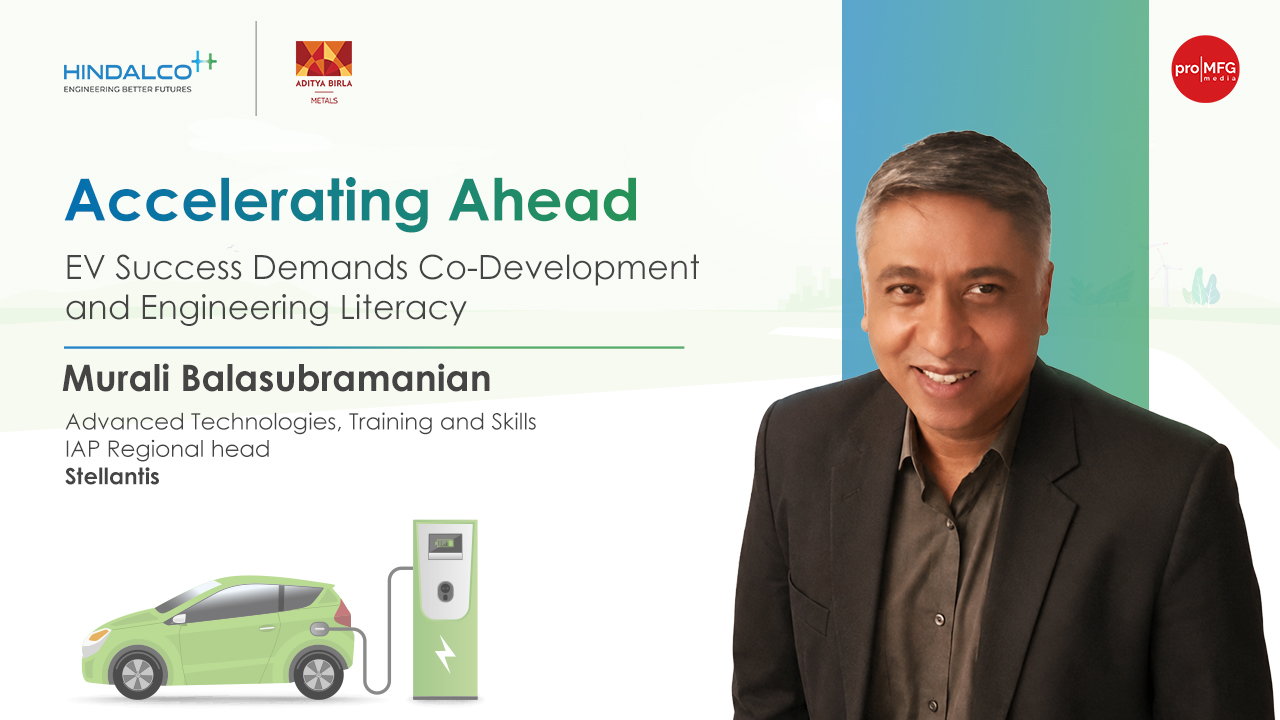
: The sheer scale of the EV transition, coupled with the pressure to slash carbon footprints while keeping vehicles affordable for cost-conscious buyers, has changed the rules of the game. Today, trying to build everything in-house isn't just expensive - it's a fast track to becoming obsolete.
This collaborative paradigm shift took center stage at the Hindalco CXO Power Breakfast, a high-stakes roundtable held on the sidelines of the 4th Edition of the ACMA Automotive Smart Manufacturing Think Turf 2026, powered by Pro MFG Media and Knowledge Partner - CAAR & Supporting Partner - GARC.
Tackling the theme, Reimagining Next Generation Mobility Platforms: Lightweighting, Smart Engineering & Sustainable Manufacturing for the EV Era, Murali Balasubramanian from Stellantis laid down a bold vision for the future. His message? All roads to automotive survival now lead to shared mind space, shared architectures, and radical ecosystem partnerships.
Stellantis is already living this philosophy. Look no further than their landmark partnership with Tata to transform India into an EV export hub serving 50 countries. To pull off a massive feat like that, Balasubramanian notes that OEMs cannot act as isolated giants. They need deep, active partnerships with material innovators like Hindalco and technical niche experts.
"We have multi-fold, conflicting challenges," Balasubramanian explained. "We need a certain scale for a real return on investment. This requires a consortium mindset - not just for basic research, but for end-to-end co-development and co-production."
When the conversation shifted to advanced materials and lightweighting, Balasubramanian injected some refreshing realism into the room. Lightweighting sounds great on paper, but in the real world, it’s a balancing act fraught with compromises. If you strip weight using new materials, you often compromise acoustic insulation, structural reliability, or robust joining methods.
Solving this puzzle requires smart engineering, but OEMs can no longer rely solely on their legacy internal systems.
Instead, the industry needs to pool data and look outward to disruptive tech like AI and digital twins. Just as Software-Defined Vehicles (SDVs) forced carmakers to learn tech competencies they didn't possess a decade ago, advanced material science requires partnering with data scientists and Tier-1 and Tier-2 suppliers who hold deeper, specialized knowledge.
"OEMs are not just givers of knowledge here; we are takers too," Balasubramanian admitted. By combining data science with multi-material simulation, the industry could rapidly accelerate its 2030 manufacturing targets.
How do we actually kickstart this level of ecosystem innovation? Stellantis has already proven a roadmap that works. Moving away from traditional corporate boardrooms, they recently hosted a physical engineering hackathon at IIT Madras. They brought actual vehicle teardown parts to the venue and challenged research scholars, students, and faculty to find real-world material solutions. The result? Game-changing ideas generated in just 48 hours.
But Balasubramanian wants to take this further, proposing a revolutionary "mass movement" centered on engineering literacy.
"Any technology roadmap - whether it’s smart manufacturing, AI, or SDVs - starts with literacy," he urged. He pledged a personal commitment: volunteering 10 experts from his own team to give two hours a week for a year to openly share technical wisdom with students, engineers, and grassroots workers.
By building a low-cost, open-source knowledge network across the country, the Indian automotive sector can democratize specialized skills. After all, the best ideas don’t always come from the top down; they bubble up from the grassroots when the ecosystem finally learns to talk to each other.

NEWSLETTER
TRENDING ON PRO MFG
MORE FROM THE SECTION