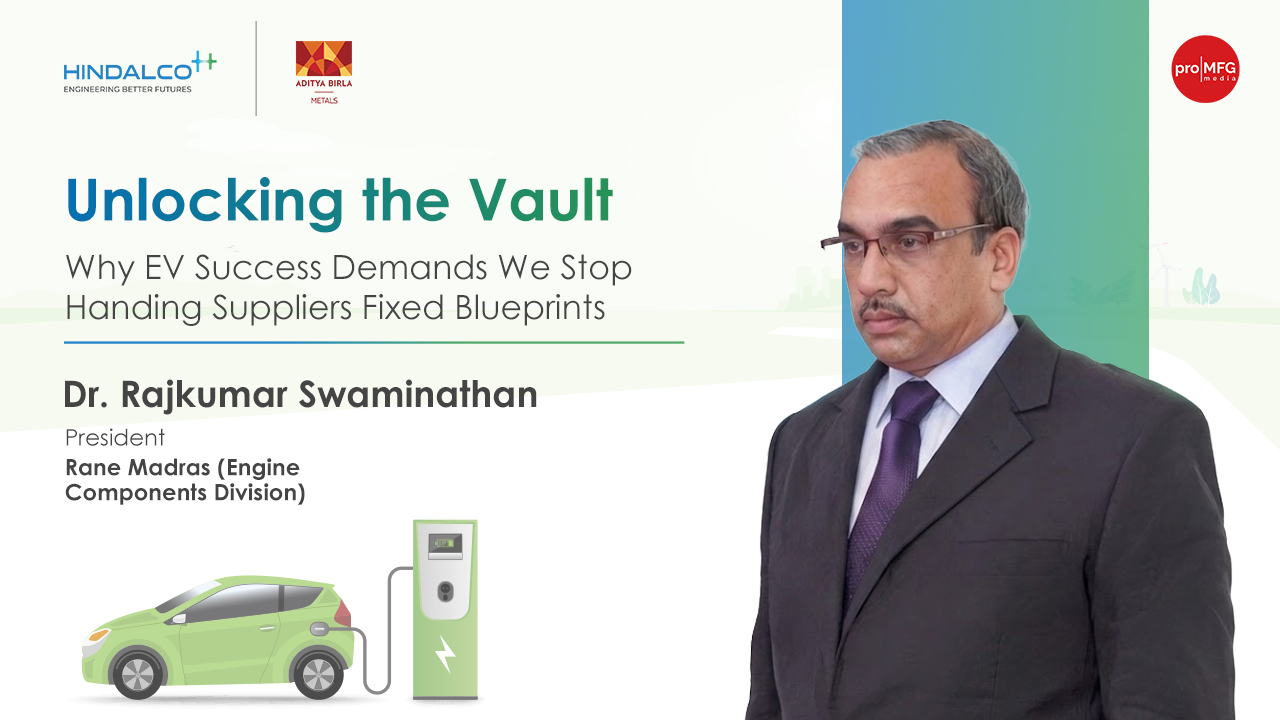
Unlocking the Vault: Why EV Success Demands We Stop Handing Suppliers Fixed Blueprints
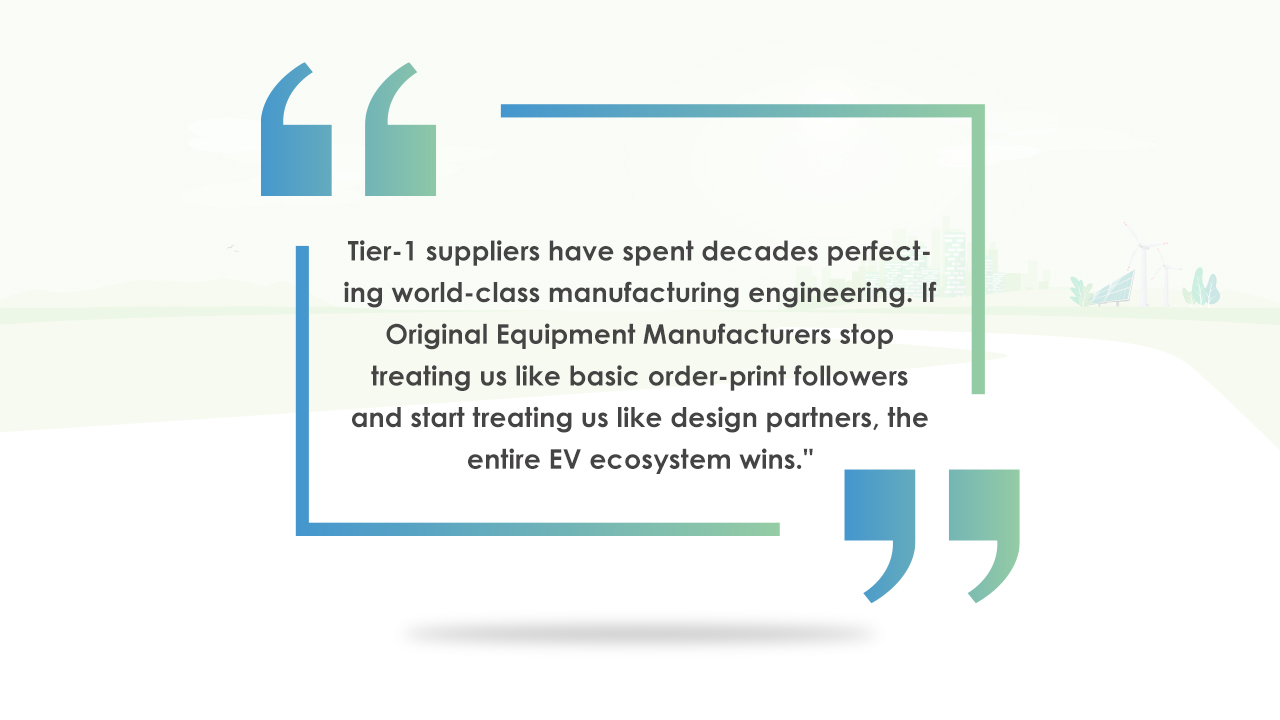
#IndustryAcademia #RaneGroup #CoCreation #MobilityReimagined #EVEra #SmartEngineering #ACMA2026 #Tier1Innovation #AutomotiveHackathon"Tier-1 suppliers have spent decades perfecting world-class manufacturing engineering. If Original Equipment Manufacturers stop treating us like basic order-print followers and start treating us like design partners, the entire EV ecosystem wins." - Dr. Rajkumar Swaminathan, President, Rane Madras (Engine Components Division)
June 2026 : For decades, the Indian automotive supply chain has run on a reliable, if slightly uninspired, sequence: the Original Equipment Manufacturer (OEM) designs a component, creates a detailed "print," and hands it down to a Tier-1 supplier with a simple instruction: build this exactly as written.
While this dynamic kept legacy internal combustion vehicles rolling off assembly lines smoothly, it is rapidly becoming a bottleneck in the electric vehicle era. The sheer speed of technological change means that by the time a fixed design goes through the traditional engineering gates, the market has already moved on.
This friction point became a major focal point at the Hindalco CXO Power Breakfast, a high-stakes roundtable hosted on the sidelines of the 4th Edition of the ACMA Automotive Smart Manufacturing Think Turf 2026, powered by Pro MFG Media and Knowledge Partner - CAAR & Supporting Partner - GARC.
Industry heavyweights gathered under an urgent theme: Reimagining Next Generation Mobility Platforms: Lightweighting, Smart Engineering & Sustainable Manufacturing for the EV Era.
Among the prominent speakers pushing for a cultural reset was Dr. Rajkumar Swaminathan, President of Rane Madras (Engine Components Division). He argued that to truly accelerate localized EV technology and build a self-reliant manufacturing sector, the industry must unleash the hidden design and problem-solving power of its Tier-1 partners.
Tier-1 suppliers are far more than just high-volume factories. Over decades of global exposure, companies like the Rane Group have built deep internal R&D capabilities, advanced material testing rigs, and specialized process engineering expertise. Yet, under the old playbook, that creative intelligence is often left at the door.
"As Tier-1 suppliers, we have an incredible repository of innovative ideas and alternative manufacturing processes," Dr. Rajkumar emphasized. "By and large, we still manufacture strictly 'as per the print.' If OEMs give us the creative breathing room early in the development cycle to express, adapt, and showcase these innovations, we can implement breakthroughs that drastically reduce vehicle weight, boost efficiency, and save structural costs."
When an OEM co-creates with a Tier-1 partner rather than treating them like a rigid order-taker, development loops shrink. Suppliers can flag manufacturing friction points and suggest smarter engineering alternatives before millions of rupees are sunk into inflexible tooling dies.
Dr. Rajkumar doesn't just want to see a shift in supplier relations - he wants a radical rewrite of how the entire industry collaborates with academic research centers. Echoing the sentiment that corporate research needs an injection of rapid, real-world grit, he proposed building an actionable industry roadmap centered around targeted, fast-paced engineering hackathons.
The idea is beautiful in its simplicity: take the high-pressure, collaborative energy of a software hackathon and drop it directly onto the shop floor.
Dr. Rajkumar shared his own successful experiences with this model, recalling instances where tough, lingering manufacturing issues were thrown at a collective pool of engineers and academic minds - specifically citing collaborative work with IIT institutions.
"When you put raw, sharp minds in a room together and give them a highly specific corporate problem statement, you can unlock game-changing, viable solutions in less than 48 hours," Dr. Rajkumar noted.
However, Dr. Rajkumar also injected an important dose of operational realism into the roundtable: while ideation can happen in a single weekend, the real corporate hurdle is implementation.
Too often, brilliant ideas born out of isolated hackathons or university projects stall because they hit a wall of corporate inertia or slow validation procedures. To fix this, he believes the upcoming automotive roadmap must include a structured, quarterly follow-through framework where corporate experts are directly assigned to shepherd those 48-hour breakthroughs through testing and into active assembly lines.
The message coming out of the ACMA roundtable is clear: India has all the necessary raw components to dominate the next generation of mobility - from advanced materials to sharp academic minds and powerhouse Tier-1 manufacturing infrastructure. The missing link is trust. When OEMs finally trust their supplier base enough to throw away the rigid, pre-baked blueprints and build things together, the entire local ecosystem moves from a fast follower to a global pacesetter.

NEWSLETTER
TRENDING ON PRO MFG


MORE FROM THE SECTION