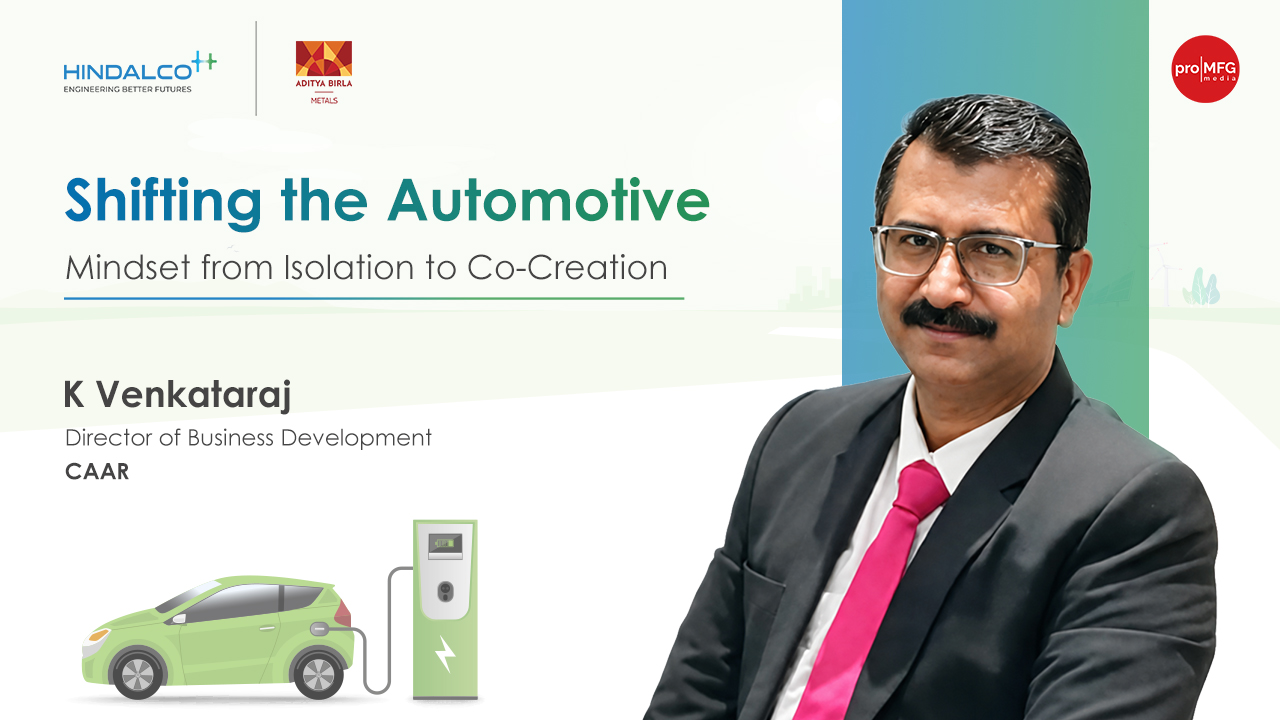
Shifting the Automotive Mindset from Isolation to Co-Creation
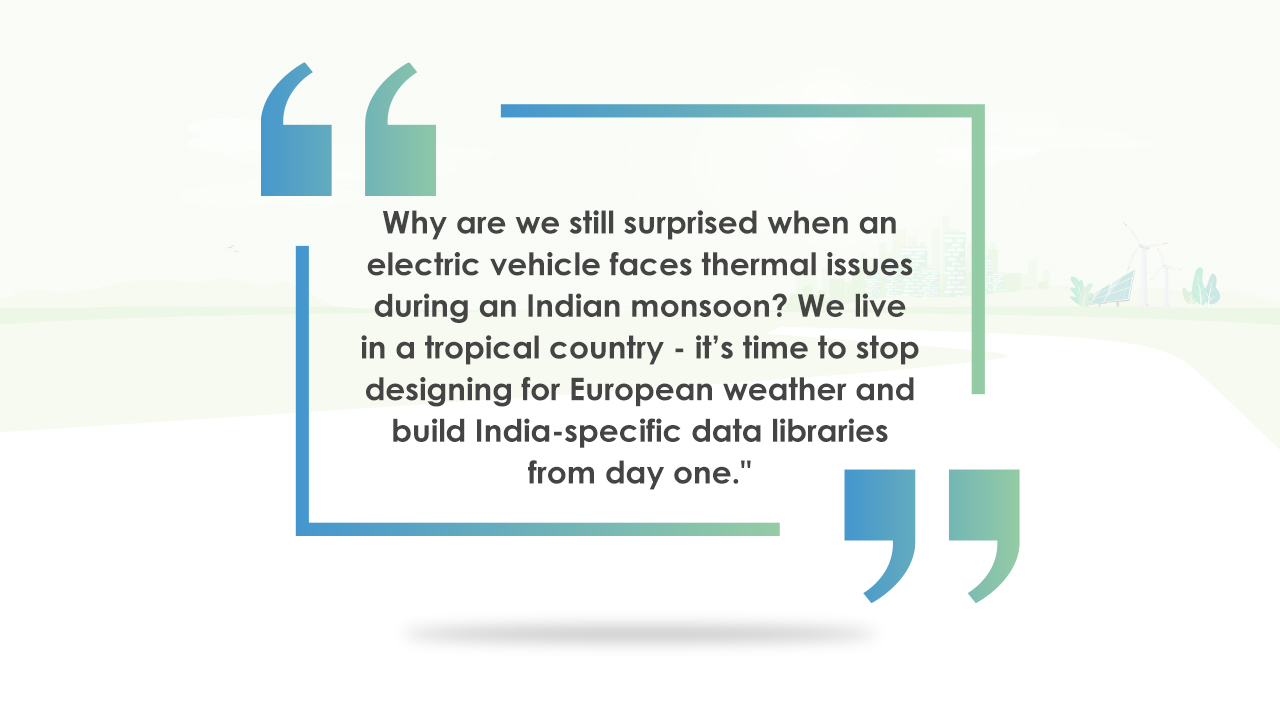
#MobilityReimagined #EVEra #SmartEngineering #CoDevelopment #AerospaceToAutomotive #ThermalManagement #GenerativeAI #DeepTechIndia #CAAR #ACMA2026"Why are we still surprised when an electric vehicle faces thermal issues during an Indian monsoon? We live in a tropical country - it’s time to stop designing for European weather and build India-specific data libraries from day one." - K Venkataraj, Director of Business Development at CAAR
June 2026 : For decades, the automotive industry looked at the space and aerospace sectors as distant, ultra-luxurious cousins. Space exploration and aviation operated with massive budgets, decades-long planning, and an intense reliance on collective, national-level scientific research. Car manufacturing, by contrast, was a fast-moving, fiercely competitive consumer game where individual brands kept their breakthroughs locked behind thick, proprietary walls.
But as vehicles evolve into high-tech, software-driven electric platforms, the old boundaries are blurring. The automotive sector is facing complex material challenges, safety requirements, and software hurdles that no single company can solve alone.
This reality check was delivered at the Hindalco CXO Power Breakfast, a high-stakes roundtable hosted on the sidelines of the 4th Edition of the ACMA Automotive Smart Manufacturing Think Turf 2026, powered by Pro MFG Media and Knowledge Partner - CAAR & Supporting Partner - GARC.
Diving into the theme, Reimagining Next Generation Mobility Platforms: Lightweighting, Smart Engineering & Sustainable Manufacturing for the EV Era, K Venkataraj, Director of Business Development at CAAR, called for a complete cultural reset. He argued that the Indian automotive industry must rapidly adopt the hyper-collaborative models pioneered by the aerospace sector to thrive in the EV age.
When discussing advanced materials like Carbon Fiber Reinforced Polymers (CFRP), Venkataraj highlighted a classic automotive trap: scaling friction. CFRP is a phenomenal material for lightweighting on a small scale, but when it enters high-volume production, it can inflate manufacturing costs by an unsustainable 25%.
"If we want carbon fiber to win the race in India, we can’t look at individual corporate components," Venkataraj warned. "We need a country-wide, large-scale production strategy to drive the economics down."
Venkataraj pointed out that the traditional model of "company + college" or industry-academia partnerships is no longer enough to pace global disruption. True self-reliance requires a quad-helix approach: Company + Company + Government + Academia.
He challenged the corporate leaders in the room with a very practical financial strategy:
"If your organization is spending 100 rupees on internal R&D, take just two rupees and divert it toward government co-funded joint research schemes like the Anusandhan National Research Foundation (ANRF). The government has the funds and the schemes ready - the industry just needs to show up and co-invest."
To make this frictionless, Venkataraj opened the doors to CAAR's massive infrastructure. Backed by the institutional brand of IIT Madras, CAAR is actively offering a 20-acre sustainability center in Pondicherry and a brand-new 40,000-square-foot facility in the Tamil Nadu Knowledge City. These spaces are designed to act as neutral, collaborative ground where competing OEMs and Tier-1s can co-develop structural baselines, bypass heavy corporate bureaucracy, and utilize state funding.
One of the most hard-hitting moments of the roundtable came when Venkataraj addressed the persistent thermal and reliability issues plaguing modern EVs during India's intense weather cycles, like the monsoons in Kerala.
"Why are we getting surprised by thermal management issues when we know this country is entirely tropical?" he asked.
The fix requires building open-source, India-specific validation data libraries. Instead of testing vehicles against generic European or American road profiles, the industry needs a centralized repository of local environmental data. Furthermore, Venkataraj stressed that safety and regulatory testing, like the Bharat NCAP, must be integrated at Technology Readiness Level 1 (the earliest conceptual stage) rather than waiting until a vehicle is at Level 6 or 7, when fixing an architectural flaw becomes astronomically expensive.
Moving from hardware to software, Venkataraj announced that CAAR has partnered with Accenture to establish an SDV (Software-Defined Vehicle) Academy. Utilizing a digital Learning Management System patterned after India's highly successful NPTEL model, the academy is built to democratize software engineering skills for the automotive workforce.
The message from CAAR is clear: the infrastructure, the government funding, the academic brilliance, and the digital learning tools are already standing by in India. The automotive industry simply needs to shed its legacy, insular mindset, pull its resources together, and start co-creating the future of mobility in the open.

NEWSLETTER
TRENDING ON PRO MFG



MORE FROM THE SECTION