Moving Parts, Smarter Decisions: The Physical and Digital Synergy Reshaping Indian Automotive Lines
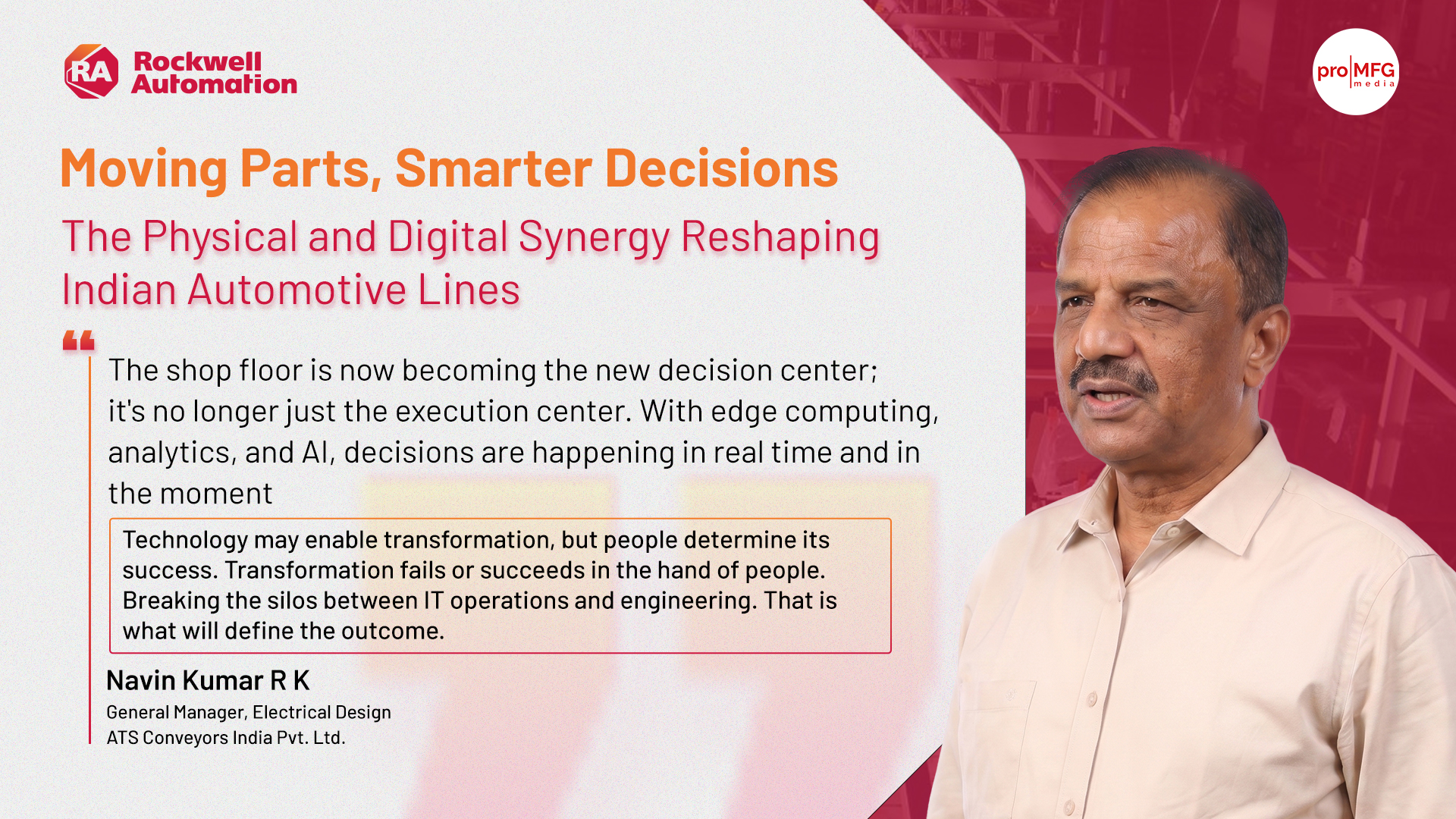
#SmartManufacturing2026 #ProMFGMedia #RockwellAutomation #ATSConveyors #MaterialHandling #IndustrialAutomation #AutomotiveIndia #SmartFactory #IndustrialAI #EdgeComputing“The ultimate backbone of a smart factory isn’t just the intelligence of its data, but the physical agility of its movement.” - Navin Kumar R K, General Manager, Electrical Design - ATS Conveyors India Pvt. Ltd.
June 2026 : When we discuss the "software-defined factory," the mind naturally drifts to cloud architectures, complex algorithms, and lines of code. It is easy to forget that before a vehicle can be updated over-the-air, its physical components must first be cast, painted, assembled, and moved seamlessly across a massive factory floor. At Rockwell Automation's Smart Manufacturing Automotive Summit 2026, powered by Pro MFG Media, this delicate intersection of heavy industrial machinery and cutting-edge intelligence took center stage.
Bringing this critical perspective to life, Navin Kumar R K, General Manager, Electrical Design - ATS Conveyors India Pvt. Ltd., pulled back the curtain on the actual physical muscle driving India's smartest automotive plants. Through an extensive OEM customer presentation, Navin Kumar demonstrated how advanced conveyor networks and material handling systems are no longer passive infrastructure - they are the dynamic, automated foundation upon which the future of smart manufacturing is built.
Modern automotive manufacturing is an intricate dance of logistics, requiring flawless precision across distinct assembly zones. From Body-in-White (BIW) buffer logistics to highly sensitive battery storage systems for Electric Vehicles (EVs), the mechanical demand on automated handling has never been higher.
The summit highlighted how specialized conveying systems - including friction drives, automated storage and retrieval systems (ASRS), and Electrified Monorail Systems (EMS) - are actively solving complex floor constraints for global giants like JLR, Tata Motors, and Mahindra. For instance, in modern underbody assembly lines, customized monorail systems are no longer just moving parts; they are communicating with localized automation systems to adjust speeds, manage buffer bottlenecks, and ensure zero-delay operations.
However, the true magic occurs when this robust mechanical infrastructure hooks directly into the digital thread. As the summit's concluding discussions emphasized, the industry has crossed a critical threshold where physical automation and digital intelligence must act as a single organism. This convergence is redefining the shop floor through four foundational realities:
Prescriptive Floor Logice: AI has officially outgrown the laboratory phase. By embedding localized machine-learning models directly alongside advanced conveyor networks, operations are transitioning from basic predictive alerts to prescriptive actions. The machines aren't just predicting a mechanical fault; they are actively adjusting line speeds to mitigate it.
The Floor as a Decision Hub: Driven by low-latency edge computing, the factory floor has evolved from a simple execution center into a self-contained decision hub. Real-time data is processed immediately next to the machines, dramatically cutting down the need for manual escalations and delayed post-fact reporting.
The New Holy Trinity: True high-performance manufacturing requires a disciplined balance of three key forces: speed, zero-defect quality, and sustainability. Modern plants use comprehensive digital twins to simulate complex conveyor layouts before a single bolt is turned, compressing time-to-market while embedding energy-efficient practices directly into everyday operations.
Despite the incredible leap in machine intelligence, the summit concluded on a deeply grounding note: technology only sets the stage, but human operators determine the final outcome. The future of smart manufacturing doesn't look like an empty, cold factory floor. Instead, it relies on a collaborative dynamic where a "smart workforce" uses AI as an invaluable ally to make sharper, more confident choices.
Ultimately, every advanced monorail system, cloud algorithm, and automation platform must be ruthlessly anchored to clear business metrics. True success isn't measured by the complexity of the tech stack, but by higher throughput, maximized asset utilization, and rapid responsiveness to a fast-moving market. By matching physical engineering excellence with disciplined digital strategy, India's automotive sector is building an operational ecosystem that is incredibly agile by design and resilient by intent.

NEWSLETTER
TRENDING ON PRO MFG



MORE FROM THE SECTION