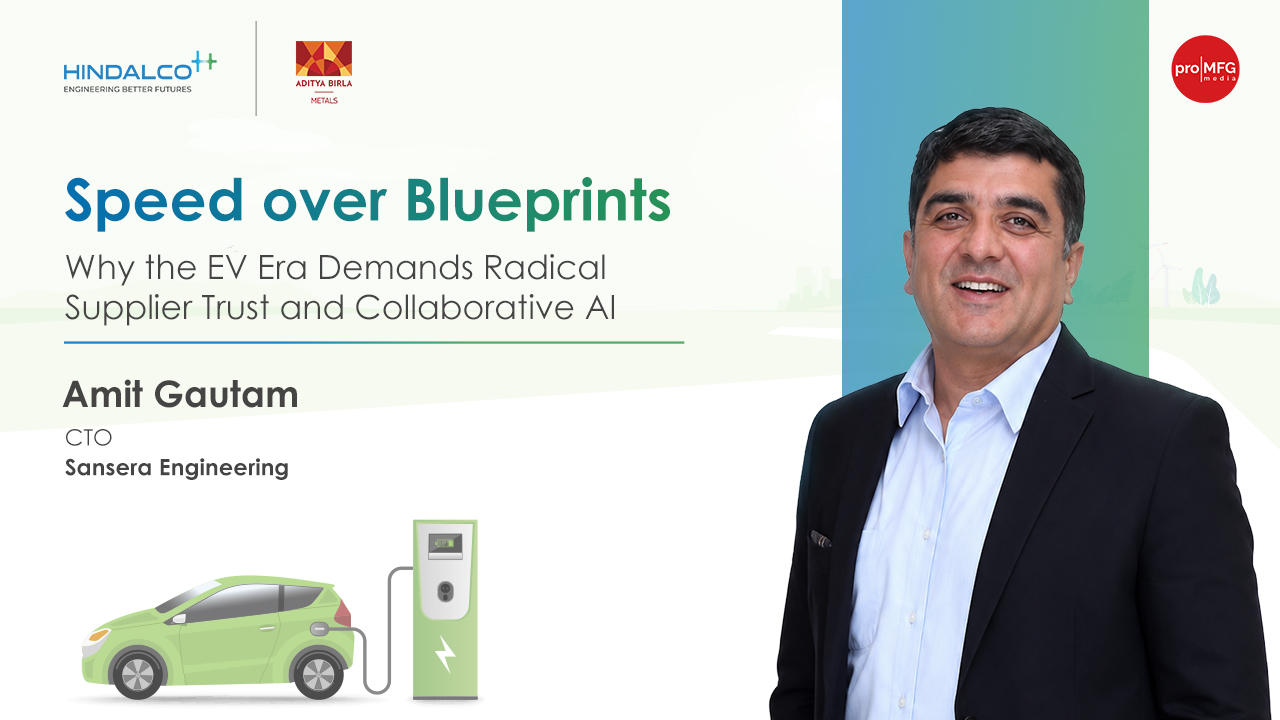
Speed over Blueprints: Why the EV Era Demands Radical Supplier Trust and Collaborative AI
#MobilityReimagined #EVEra #SmartEngineering #SupplyChainAgility #AIinManufacturing #GlobalBenchmarking #SanseraEngineering #ACMA2026 #DigitalFootprint"The metric of modern innovation isn't just what you build, but how fast you can validate it. If we don’t slash our development timelines in half, global benchmarks will leave us behind." - Amit Gautam, CTO - Sansera Engineering
June 2026 : The ultimate battleground for electric vehicles isn't just fought in the sleek lines of a vehicle's final design - it is fought against the clock. Historically, Indian automotive development followed a comforting, slow-moving rhythm: an Original Equipment Manufacturer (OEM) would draw up a meticulous blueprint and send it downstream for manufacturing. From initial concept to Start of Production (SOP), the process dragged on for 40 to 44 months. In today's hyper-disruptive EV landscape, that timeline is a relic of the past.
This reality check anchored the discussion at the Hindalco CXO Power Breakfast, a high-stakes roundtable hosted during the sidelines of 4th Edition of the ACMA Automotive Smart Manufacturing Think Turf 2026, powered by Pro MFG Media and Knowledge Partner - CAAR & Supporting Partner - GARC.
Diving into the theme, Reimagining Next Generation Mobility Platforms: Lightweighting, Smart Engineering & Sustainable Manufacturing for the EV Era, the ecosystem's finest minds debated how to position India at the forefront of global mobility.
Among the standout voices was Amit Gautam, CTO of Sansera Engineering, who brought a sharp, globally benchmarked reality check to the room. To survive, he argues, the industry must fundamentally change how it treats supplier design expertise and how it deploys Artificial Intelligence (AI).
Sansera Engineering is actively living the shift toward rapid, trust-based engineering. Working closely with global automotive giants like Ford and Stellantis in the US, Gautam has seen a massive behavioral change. Global OEMs are no longer dropping rigid blueprints onto suppliers' desks. Instead, they are sending Statement of Requirements (SORs) and asking suppliers to co-create the components.
"They don’t want to give us a locked blueprint because we are the ones who know the exact manufacturing conditions, the best cost fits, and how to radically reduce development time," Gautam explained.
By pulling Tier-1 suppliers into the early design phase, companies eliminate endless back-and-forth iterations later. It’s a level of expert bandwidth that smaller Tier-2 or Tier-3 players simply can’t match. While startups might find agility in smaller shops, it takes the deep engineering infrastructure of an established Tier-1 partner to fully validate and scale a complex EV component to meet strict regulatory and customer standards.
To show exactly what India is up against, Gautam pointed directly to the global pacesetter: China. While India still averages nearly four years to bring a vehicle from scratch to the factory floor, Chinese players are crushing that timeline, pulling it off in just 20 to 21 months. The result? A staggering 108 distinct EV models launched in China last year alone, backed by gargantuan R&D engines like BYD’s innovation center, which brought in 130,000 engineers in a single year.
How do we compete with that kind of scale? We don't do it by throwing more bodies at the problem. We do it through an aggressive digital footprint - linking early supplier involvement, academic material analysis (through bodies like CAAR), and automated engineering ecosystems.
Sansera isn't just preaching speed; they are practicing it. Over the last six months, the company has integrated specialized AI systems deeply into its commercial and engineering workflows. By feeding massive amounts of legacy data into their AI ecosystem, they have revolutionized their quoting process.
"When we receive a Request for Quotation (RFQ) from a customer, we are no longer talking in terms of weeks or days to respond," Gautam revealed. "We are talking in terms of hours."
This collaborative AI approach doesn't just spit out numbers. It instantly cross-references the client's needs against the actual machine availability and human capabilities inside Sansera's physical plants. It smooths out design reviews, automates quality gates, and perfectly aligns components with OEM specifications before a single piece of metal is cut.
But Gautam warns that AI shouldn't remain an exclusive luxury for giant corporations. The real breakthrough happens when the technology is democratized. Smaller MSMEs and component suppliers often lack the financial bandwidth, cloud infrastructure, or technical tokens required to run advanced AI engines.
Gautam left the roundtable with a powerful call to action: Indian OEMs and major Tier-1 players must collaborate to build a unified, shared AI package - a digital bundle that can be extended across the entire manufacturing supply chain. When the whole ecosystem shares a single digital footprint and a common AI system, the entire country moves faster. The EV transition is an absolute race against time, and a supply chain is only as fast as its slowest link.

NEWSLETTER
TRENDING ON PRO MFG
MORE FROM THE SECTION