The End-User Reality: Shifting from Simple Automation to Connected Intelligence
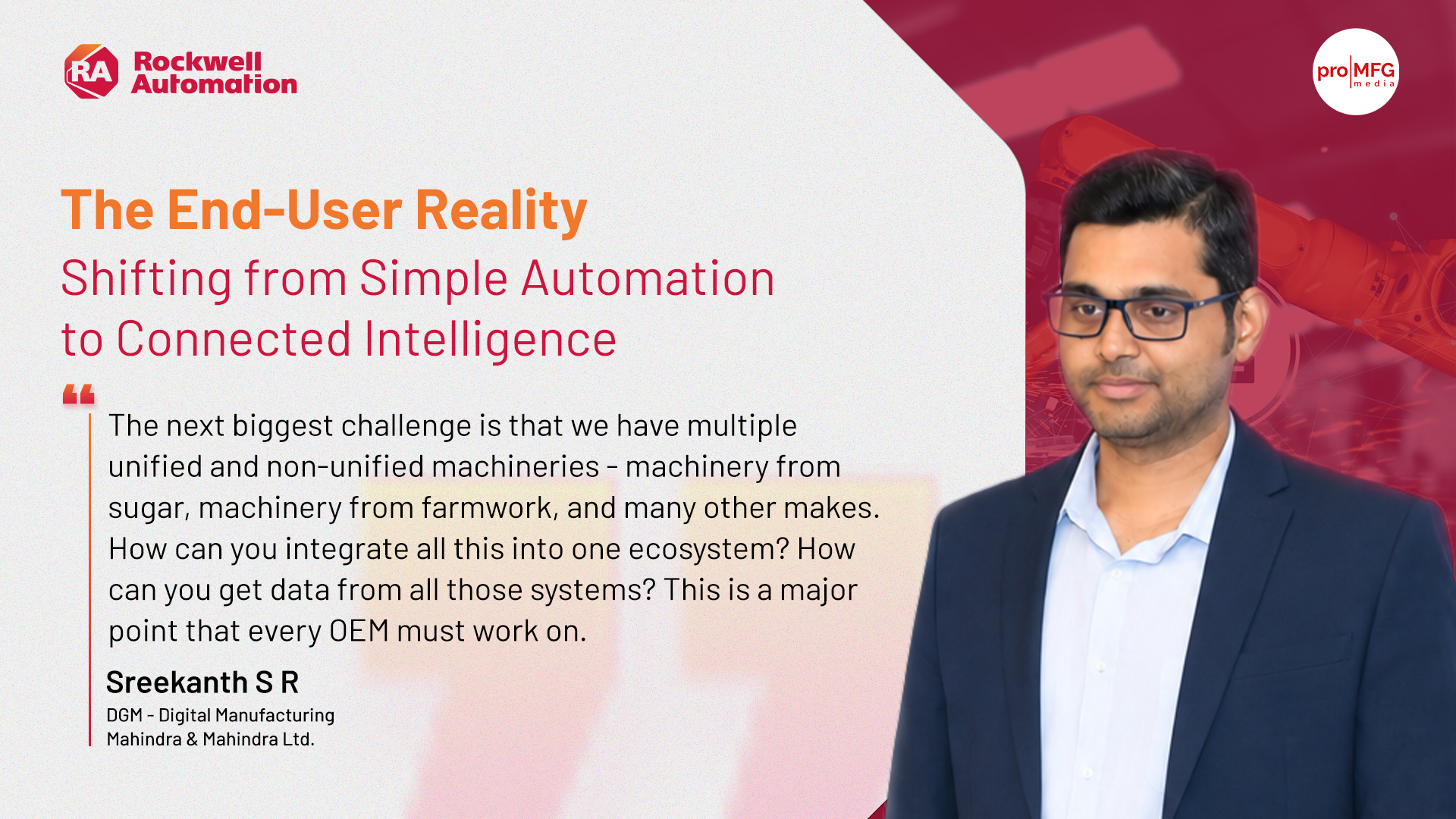
#SmartManufacturing2026 #ProMFGMedia #RockwellAutomation #MahindraAndMahindra #ConnectedIntelligence #IndustrialAI #AutomotiveIndia #SmartFactory #ITOTConvergence #OEEOptimization“The factory of the future will not be measured by how much data it collects, but by how wisely it uses that data to learn, adapt, and self-heal.” - Sreekanth S R, DGM - Digital Manufacturing at Mahindra & Mahindra Ltd
June 2026 : A few years ago, the conversation around digital transformation in the automotive sector was dominated by massive, looming crises. Global supply chains were choked, the semiconductor shortage was at its peak, and original equipment manufacturers (OEMs) were operating under immense production pressure. At that time, simply standing up a basic digital twin or executing virtual commissioning felt like a massive win. Fast forward to Rockwell Automation's Smart Manufacturing Automotive Summit 2026, powered by Pro MFG Media, and the reality on the shop floor has grown significantly more demanding.
Sharing an authentic end-user perspective, Sreekanth S R, DGM of Digital Manufacturing at Mahindra & Mahindra Ltd, delivered an insightful reality check on what smart manufacturing actually looks like in practice. The operational pressures have only intensified, driven by an urgent market demand for further compressed development cycles. To survive, Indian automotive manufacturers must quickly move past conventional, descriptive data collection and step boldly into the era of prescriptive, autonomous manufacturing.
In the earlier days of industrial IoT, the common belief was that more data automatically meant better operations. Sreekanth shared a candid lesson from his own early journey - a massive pilot project connecting over 500 robots, 50 PLCs, and 200 allied shop floor assets. The result? The sheer volume of raw data was completely overwhelming, proving that data collection is the easy part. The real challenge lies in context.
When a multi-machine cell experiences an unexplained drop in Overall Equipment Effectiveness (OEE), operators historically wasted hours digging through isolated PLC logs and HMI monitors, only to realize the root cause wasn't the machine itself, but a hidden, un-tracked system bottleneck. To solve this, Mahindra established a clear strategy: filter the noise, narrow the focus down to two or three hyper-specific KPIs, and build a dedicated data layer. From there, the team deployed custom-built internal AI models to handle highly targeted use cases, including spot-welding monitoring systems, paint defect tracking, and vision-guided analytics for stamping panels.
Achieving this level of connected intelligence is impossible if a factory's core technologies are fighting a silent internal war. Operational Technology (OT) teams can implement the most advanced Ethernet loops, Wi-Fi networks, and IO-link setups on the machinery, but if those systems are completely out of sync with the Information Technology (IT) department, scaling smart manufacturing grinds to a halt. True scale requires unified organizational goals where IT and OT function as a single, supportive unit.
Furthermore, real-world automotive lines are rarely uniform. They are complex, brownfield environments crowded with legacy equipment from dozens of different global makers across different generations. Building a future-ready facility means engineering an open, unified ecosystem architecture capable of securely blending these disparate machines into a single data fabric.
The ultimate metric for success is speed-to-market. Global competitors, particularly in China, are aggressively slashing vehicle development lifecycles down to a mere two to three years. For India to match and exceed this pace, the traditional, slow-moving vendor-client relationship must transform into an active culture of co-creation.
OEMs bring the raw operational aspirations and shop-floor realities, technology providers bring global benchmarks, and integrators bridge the execution gap. By combining these minds, utilizing low-latency edge computing to solve real-time safety and quality challenges, and deploying vision analytics to eliminate defects at the source, the Indian automotive sector is entering a true operational renaissance. The future does not belong to the factories that accumulate the most data, but to those that deploy it securely, sustainably, and collaboratively.

NEWSLETTER
TRENDING ON PRO MFG


MORE FROM THE SECTION