Beyond the Digital Horizon: The Dawn of the AI-First Enterprise
#ProMFGMedia #SmartManufacturing #Industry40 #EnterpriseAI #ImageGraphix #DigitalLeadership #AITransformation #RefexGroup #ZeroBasedThinking #WorkforceReskilling“The term ‘Digital Transformation’ is already outdated. If you aren’t thinking ‘AI-First,’ you aren’t transforming - you’re just playing catch-up in a world that has already moved on.”
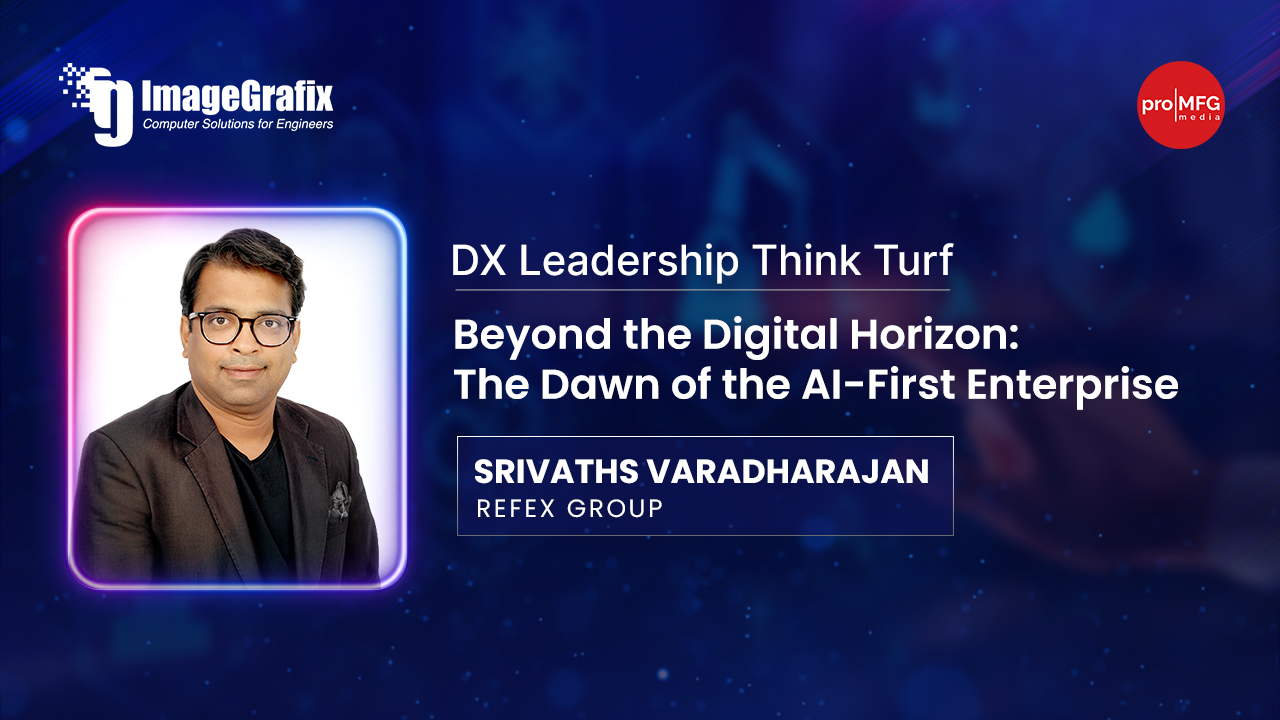
March 2026 : In the world of industrial evolution, we often talk about "Digital Transformation" as the ultimate destination. But according to Srivaths Varadharajan, Group CTO of the Refex Group, that destination is already in the rearview mirror.
At the DX Leadership Think Turf Roundtable hosted by ImageGraphix and powered by Pro MFG Media, Srivaths challenged a room full of manufacturing CXOs to stop "re-engineering" the past and start disrupting the future. The theme of the session, “Digital Leadership in Manufacturing: From Connected Assets to Intelligent Enterprises,” served as a launching pad for a provocative, high-energy take on why the traditional manufacturing mindset is at risk of becoming redundant.
Srivaths, bringing a decade of experience from the fast-paced Banking and NBFC sectors, doesn't mince words. "We have shut down the word 'Digital Transformation' in our organization," he stated. "It’s been replaced by AI Transformation." For the Refex Group, this isn't just a semantic change. It represents a Zero-Based Thinking approach. While legacy companies struggle to patch up 30-year-old monoliths, Srivaths advocates for building a "hollow core" - keeping essential legacy systems for compliance but building a vibrant, AI-led ecosystem around them. The results? Refex recently took 14 group company websites live in just 20 minutes each, with near-perfect accuracy and user experience.
The old way of working - lengthy Business Requirement Documents (BRDs) and slow development cycles - is dead. Srivaths’ team consists of solution architects who work with business units in real-time. "We are very high on experimentation and ready to fail," he noted. By leveraging low-code and no-code platforms with embedded AI, they can turn a plain-English paragraph of requirements into a 40% ready system almost instantly. This allows the human element to focus on the remaining 60%: the high-level control mechanisms and security frameworks like ISO 27001.
Srivaths pointed to the Government of India’s digital initiatives - like UPI and Jan Dhan - as the blueprint for what’s coming to manufacturing. The next decade won’t just be about software; it will be about the triangulation of Semiconductors, IoT, and Smart Machines. This integration creates a "killer combination" where the software doesn't just monitor the hardware; it understands it. We are moving toward Responsible AI, where the system knows how to eliminate "noise" from the massive amounts of data generated by sensors, ensuring that decision-making is sharp, secure, and lightning-fast.
Perhaps the most sobering part of Srivaths' address was his message to the workforce. "Most of the workforce in this room is already outdated," he warned.
To stay relevant in the next three years, manufacturing leaders must build three core capabilities:
1. Logical Thinking: Moving away from rote processes to high-level problem solving. 2. Design Thinking: Prioritizing the user experience and form factor (making enterprise tools as easy to use as a mobile app). 3. Structured Process Approach: Using AI to automate 30-40% of mundane tasks to reduce turnaround time and increase "delta" contributions.
The roundtable concluded with a look at the "Next Big Thing": Integrated Enterprise AI Architecture. Currently, the market is flooded with individual tools, each with its own logic. Srivaths predicts the next major breakthrough will be a system that integrates these tools into a secured, controlled ecosystem - a "Master Health Checkup" for the entire enterprise.
"Transformation will happen whether you want to be in a catch-up place or a leader," Srivaths concluded. The message to the industry was clear: Adopt the tools, reskill your teams, and embrace the disruption - before it embraces you.

NEWSLETTER
TRENDING ON PRO MFG

MORE FROM THE SECTION