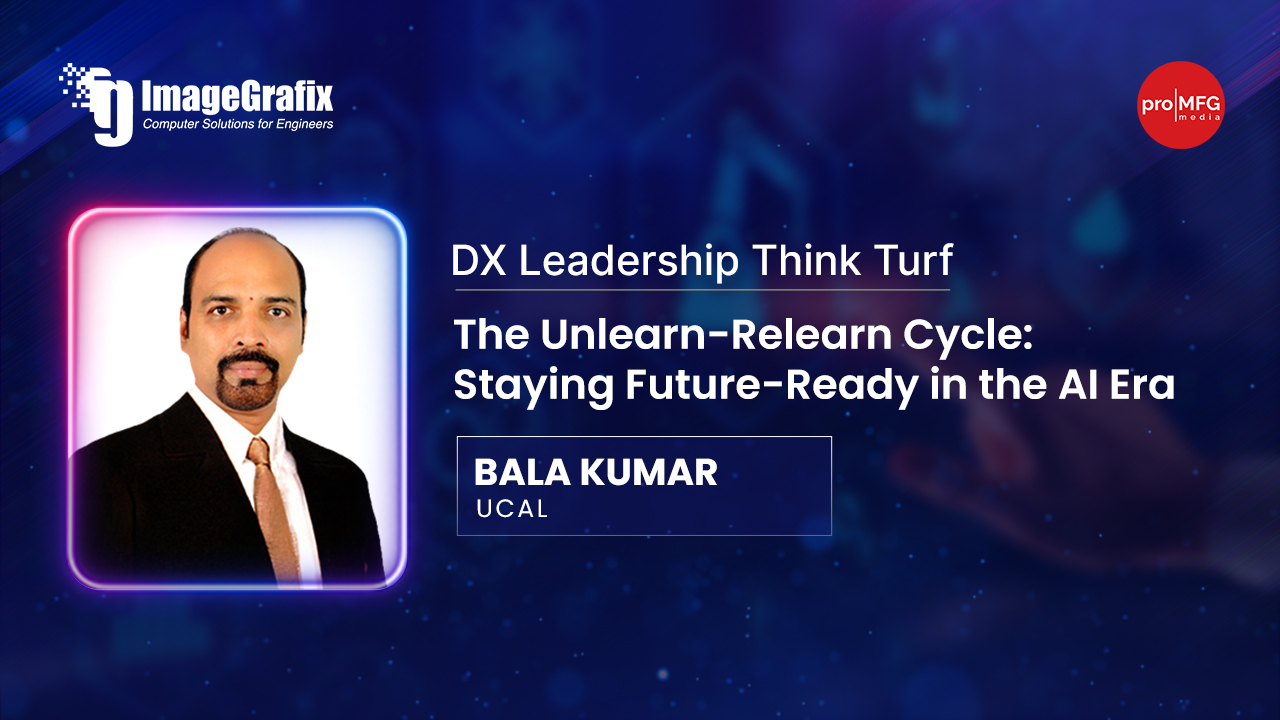
The Unlearn-Relearn Cycle: Staying Future-Ready in the AI Era
#DigitalTransformation #SmartManufacturing #Industry40 #UCAL #ImageGraphix #DataAnalytics #AIinManufacturing #Automation #FutureOfWork #ProMFGMedia“The true measure of digital transformation isn’t the volume of data you collect, but the velocity at which you turn a thousand machine events into a single, smart business decision.”
April 2026 : In the modern factory, machines are talkative. A single asset can throw out 1,000 events per second. Multiply that by 100 machines, and you aren’t just looking at a data stream - you’re standing under a digital waterfall. The challenge for the modern leader isn't finding data; it’s surviving it.
At the DX Leadership Think Turf Roundtable hosted by ImageGraphix and powered by Pro MFG Media, the conversation moved beyond the theoretical to the tactical. The theme, “Digital Leadership in Manufacturing: From Connected Assets to Intelligent Enterprises,” found a grounded, practical voice in Bala Kumar, Head of IT at UCAL. With a focus on agility and the human element, Bala shared how UCAL is moving past the "monotonous" to create a leaner, more responsive manufacturing engine.
For Bala, digital transformation is stripped of its hype and reduced to a core utility: Operating Smartly. "It’s about how quickly we can respond to services or recommend shifts to the organization that drive sustainability," he explained. The goal is twofold: meeting rising customer expectations and increasing employee productivity. In many manufacturing setups, skilled workers are bogged down by manual, repetitive tasks. Digital tools are the "enablers" that give that time back, moving data from fragmented silos into a centralized location where it can finally create value.
Bala offered a sobering look at the "Big Data" trap. While it is technically possible to track every millisecond of a machine's life, collecting data and correcting data are two different battles. "Because of the junk data that comes to the platform, much of it will not be useful," Bala warned. The art of the Intelligent Enterprise lies in filtering the noise to find the signals that actually impact the bottom line.
One of the most relatable moments of the roundtable was Bala’s example of month-end sales pressure. In many legacy systems, generating an invoice is a grueling process - sometimes taking 12 minutes per entry. During the month-end, when invoices pile up, the "clock" becomes the enemy. UCAL tackled this by digitizing the process. What used to be a manual marathon is now an automated sprint: 100 invoices are now booked in just 45 minutes. "Even if they start at 11:00 PM, by 11:45 PM, the month’s books are closed," Bala noted. This doesn't just save time; it solves the "casual labor" crisis. In an industry with high attrition, you cannot afford a process that requires weeks of training. By simplifying the UI - where a user follows a basic 1-2-3 step - the system remains resilient even when the person operating it changes.
As the roundtable looked toward the next three years, Bala identified a critical shift in mindset. While AI and IoT are the tools of the trade, the real capability is internal. He highlighted three pillars:
1. AI as an Efficiency Engine: Manufacturing has only scratched the surface of AI. The scope for smart recommendation engines is massive. 2. User Adaptability: If a worker has to click through five or six screens to complete a task, the digital transformation has failed. Scaling requires "single-input, single-output" simplicity. 3. The Unlearn-Relearn Cycle: Bala’s advice to his own team is a mantra for the industry: "Learn new things, unlearn the old, and relearn for the future."
Bala concluded with a reassuring take on the AI era: AI will not take your job, but a person using AI smarter than you might. The goal for the future-ready organization is to use these tools not to replace the human, but to enable them to work at the speed of thought.

NEWSLETTER
TRENDING ON PRO MFG


MORE FROM THE SECTION