The Real-Time Revolution: Turning Data into Decisions on the Shop Floor
#DigitalLeadership #ManufacturingExcellence #Industry40 #RealTimeData #TVSUpasana #ImageGraphix #PredictiveMaintenance #SmartManufacturing #CloudComputing #ProMFGMedia“In manufacturing, data is your rear-view mirror or your GPS. If you only look at it at the end of the month, you’re just doing a post-mortem. To win, you need to see the road in real-time.”
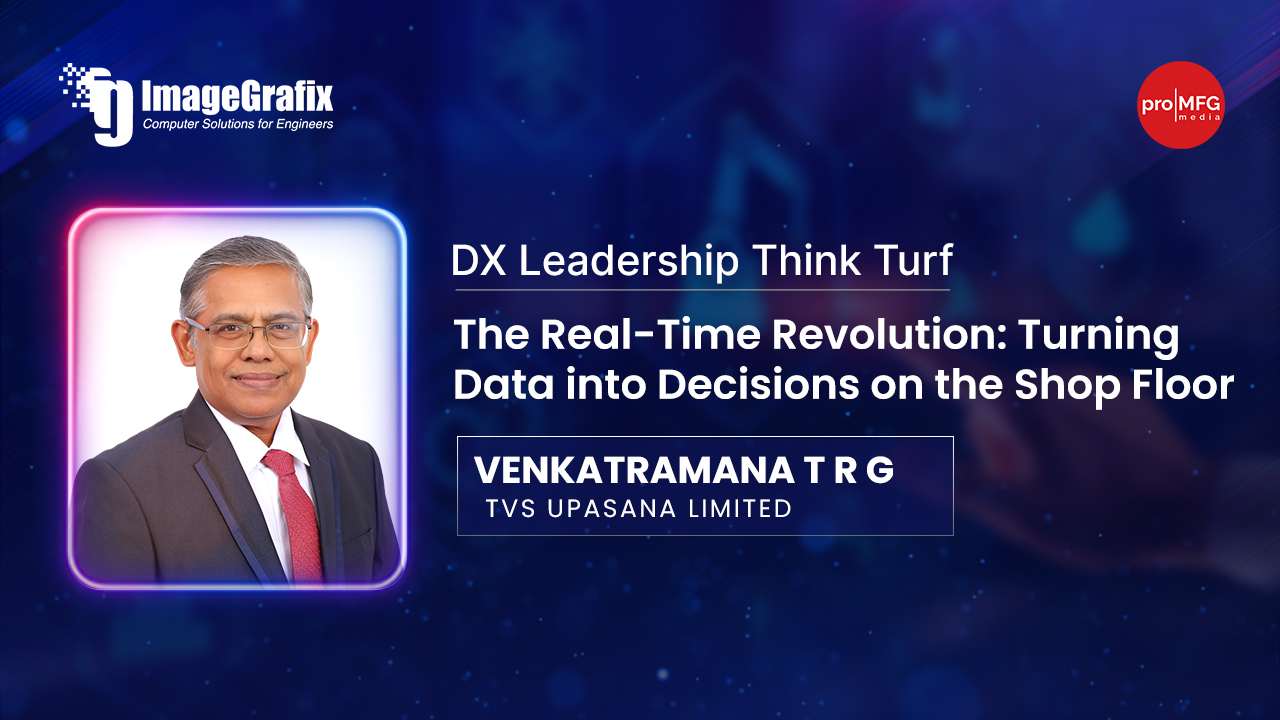
March 2026 : In the high-stakes world of plastic manufacturing, the difference between a profitable quarter and a missed target often comes down to what happens in a single hour on the factory floor. For Venkatramana T R G, Vice President at TVS Upasana Ltd, the journey from a production engineer to a business head has been defined by one core realization: top-line growth is a function of quality, but the bottom line is a function of how fast you can correct a mistake.
At the DX Leadership Think Turf Roundtable hosted by ImageGraphix and powered by Pro MFG Media, Venkatramana shared a masterclass in "pragmatic" digital transformation. His approach isn't about chasing the flashiest technology; it’s about ensuring that the right person gets the right data at the right time to make the right decision.
For many legacy organizations, the Monthly Information System (MIS) is the standard. But as Venkatramana pointed out, looking at an MIS report at the end of the month is like driving by looking only at the rear-view mirror. "By the time you see the input cost has gone up by 15%, the damage is done," he noted. True digital transformation starts when you shift to real-time data. At TVS Upasana, they’ve implemented a system where production, quality, and maintenance data is captured shift-wise - even hour-wise - using simple tablet interfaces. This allows engineers to perform "course corrections" today rather than post-mortems next week.
While many discuss complex AI algorithms, Venkatramana highlighted the transformative power of simple cloud computing. By moving from isolated Excel sheets to a centralized Google Workspace, the entire division gained a single source of truth. "The moment a customer complaint is registered on a Sunday morning, an automated alert reaches the entire team immediately," he explained. This transparency breaks down silos. Whether it’s tracking power costs, transportation, or manpower consumption, setting threshold limits on the cloud ensures that management is alerted the moment a limit is crossed - not weeks later.
One of the most pressing challenges in modern manufacturing is the scarcity of skilled manpower and high attrition rates. Venkatramana believes the answer lies in Digital Standardization. He draws a parallel to daily life: "Today, anyone can book a train ticket or an auto with an app. It’s simplified. Why can't we make manufacturing that simple?" By creating digital workflows that are as intuitive as a banking app, factories can bridge the gap for a variable workforce that speaks different languages. When the process is standardized and the interface is "easy to operate," the dependency on a single "expert" vanishes. The system itself becomes the guardian of quality.
Reflecting on his visits to over 20 advanced plants across Europe, Venkatramana’s vision for the future is clear: the integration of the Quality Management System (QMS) and the Manufacturing Execution System (MES) into the ERP (like SAP).
Digital transformation isn't a one-off project; it’s a culture of discipline. "The technology is available in plenty," he concluded, "but the value is in how effectively you convert it into a meaningful piece for the engineer on the floor."

NEWSLETTER
TRENDING ON PRO MFG


MORE FROM THE SECTION