The Industrial Reality Check: Survival in a Heterogeneous World
#CyberSecurity #OTSecurity #ManufacturingDX #Sonacomstar #ImageGraphix #DataAnalytics #AIinIndustry #LegacySystems #ProMFGMedia #FeatureEngineering #IntelligentEnterprise“In manufacturing, you don't just buy a machine; you buy its technical debt. The challenge isn't connecting the future; it's convincing the past to speak a language we can actually use.”
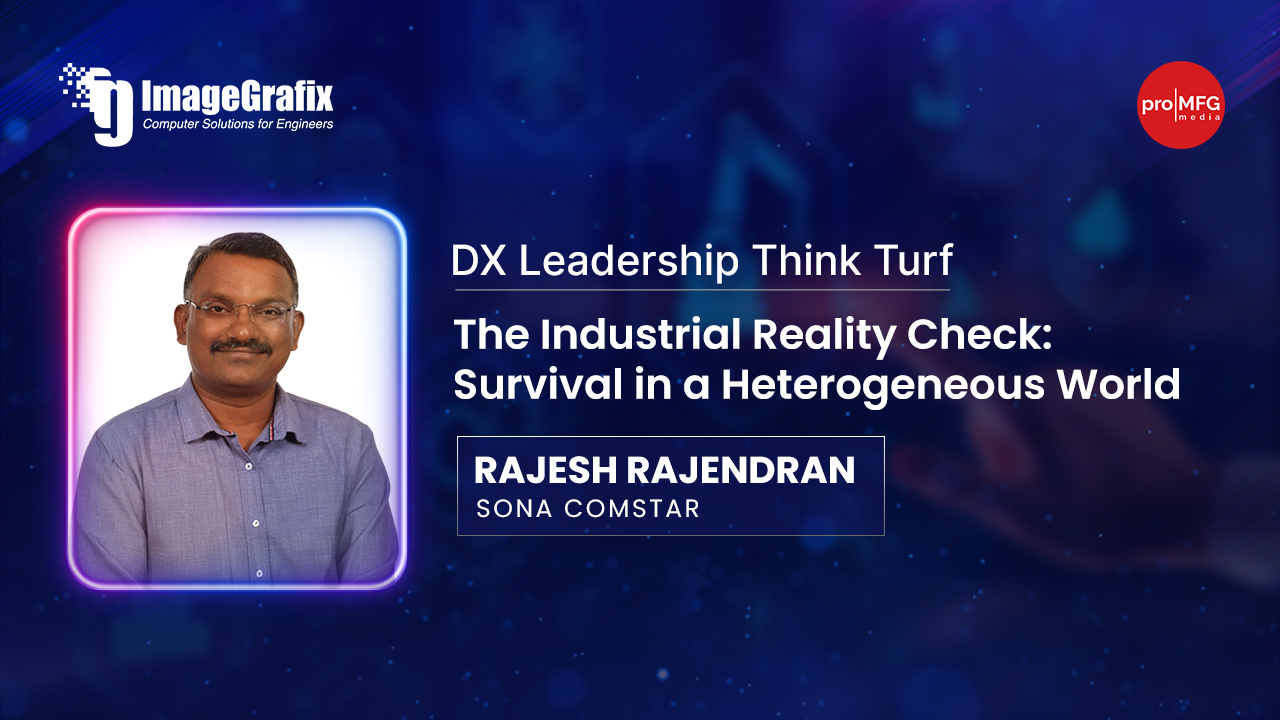
March 2026 : Digital transformation in a boardroom looks like a sleek, unified dashboard. On the factory floor, however, it looks more like a battleground of mismatched protocols, legacy hardware, and "monolith" applications. At the DX Leadership Think Turf Roundtable hosted by ImageGraphix and powered by Pro MFG Media, Rajesh Rajendran, CISO and Group Head of Analytics at Sona Comstar, delivered a refreshing, unfiltered look at the grit behind the glory.
The theme - “Digital Leadership in Manufacturing: From Connected Assets to Intelligent Enterprises” - often glosses over the "messy middle." Rajesh, with 27 years in the industry, reminded the room that while modern tech speaks API, the heavy-duty machinery that powers global manufacturing often speaks a different, much older language.
For a software engineer, the concept of a closed system without an API is "shell-shocking." But for a manufacturing leader, it’s Tuesday. "You pick a German or Japanese machine manufacturer, and they’ll give you a monolith application without thinking twice," Rajesh noted. Often, buying a 400-ton press means accepting an outdated software stack with full admin rights or nothing. There are no CSV files, no seamless integrations - just a folder and a prayer. For Rajesh, the primary challenge isn't innovation; it’s heterogeneous system integration. Adding a new, "smart" layer to a fragmented landscape often leads to more complexity and "sleepless nights" rather than clarity.
We are told to capture everything. "I’ve got 750 tags on this machine, everything is flowing into the data lake," is a common boast. But Rajesh warns that without a clear business objective, a data lake quickly becomes a Data Swamp. "I'm shutting down all dashboards," he challenged. "Tell me what decision you’re going to make." The focus must shift from "more data" to Feature Engineering. Instead of 700 parameters, can we identify the five specific features that predict the life of a press with 95% accuracy? That is the difference between a vanity project and a business solution.
Rajesh shared a powerful story about a centrifugal casting machine. The process involved pouring hot metal with massive variations in weight - a highly skilled task that hit the bottom line with every extra kilogram wasted. By implementing an AI algorithm that factored in temperature, viscosity, and volume, the team saved 9% of hot metal. But the victory wasn't just in the math; it was in the change management. Initial reluctance from "experts" was high, but eventually, the safety benefits - keeping humans away from high-temperature zones - and the undeniable accuracy of the logic won them over. It wasn't about replacing the job; it was about de-skilling the danger and the guesswork.
Looking ahead to the next three years, Rajesh identified three non-negotiable pillars for any manufacturing organization:
1. AI as an Efficiency Engine: Manufacturing has only scratched the surface of AI. The scope for smart recommendation engines is massive. 2. User Adaptability: If a worker has to click through five or six screens to complete a task, the digital transformation has failed. Scaling requires "single-input, single-output" simplicity. 3. The Frontier of OT Security: While the banking sector (BFSI) is a decade ahead in cybersecurity, Operational Technology (OT) security is a wide-open, high-risk field in manufacturing. It isn’t just about protecting systems from being hacked; it’s about protecting the AI models themselves from adversarial attacks."
Rajesh’s takeaway was a call to action for empathy and pragmatism. Before we look at the solution, we must put ourselves in the shoes of the shop floor. Only then can we build a secure, intelligent, and truly integrated enterprise.

NEWSLETTER
TRENDING ON PRO MFG

MORE FROM THE SECTION